
Encaptechno

Author name: Abhinav Bhalla

A skilled CRM consultant focused to help Organizations streamline their business processes.

8 Ways to Upskill Your Digital Marketing Team

8 Ways to Upskill Your Digital Marketing Team

The present world is governed by digitization. All potential customers spend a decent amount of their time on their screens on an everyday basis. As a result, the growth of online buyers goes up each year and millions of buyers purchase products online as the numbers keep growing consistently. 

8 Ways to Upskill Your Digital Marketing Team

Online marketing is here to stay and for years to come. Hence, it is time to acquire new online marketing skills for boosting e-commerce growth. To enhance the online marketing team’s efficiency, it is important to focus on upskilling the team players for ensuring innovation and proficiency while keeping up with clients and projects. 

To upskill your digital marketing team, you should have more clarity on the trends of digital marketing and also the best methods required to keep digital marketing afloat and thriving. Keep reading to know more about how you can help your teams and also stay competitive at the same time. 

What is Upskilling?

Upskilling is essentially the effort that enables teams to acquire new skills in a specific field. As a Project Manager, it is your responsibility to encourage your team players to keep working toward their professional and personal development. 

Obviously, this does not mean that your team members are not capable themselves but you can encourage them to walk that extra mile for delivering projects on time. What you have to understand is that your team members need that extra push from time to time for acquiring new knowledge and skills while giving you a fresh outlook every time.

You can increase your chances of accomplishing tasks more creatively, innovatively, and with much higher proficiency. In addition, it is important to ensure that the teammates also keep track of time with the latest market trends for bringing more excitement and positive collaborations at the workplace.

To put this another way, upskilling is an extremely effective workplace trend in the present world’s dynamic work culture. It is aimed at facilitating continuous learning through different development opportunities and training programs conducted either internally or externally. It helps in filling the skill gaps and allows players to find their strengths and weaknesses.

Let us now look at some of the trends you should consider for upskilling your team when it comes to online marketing. 
What is Upskilling

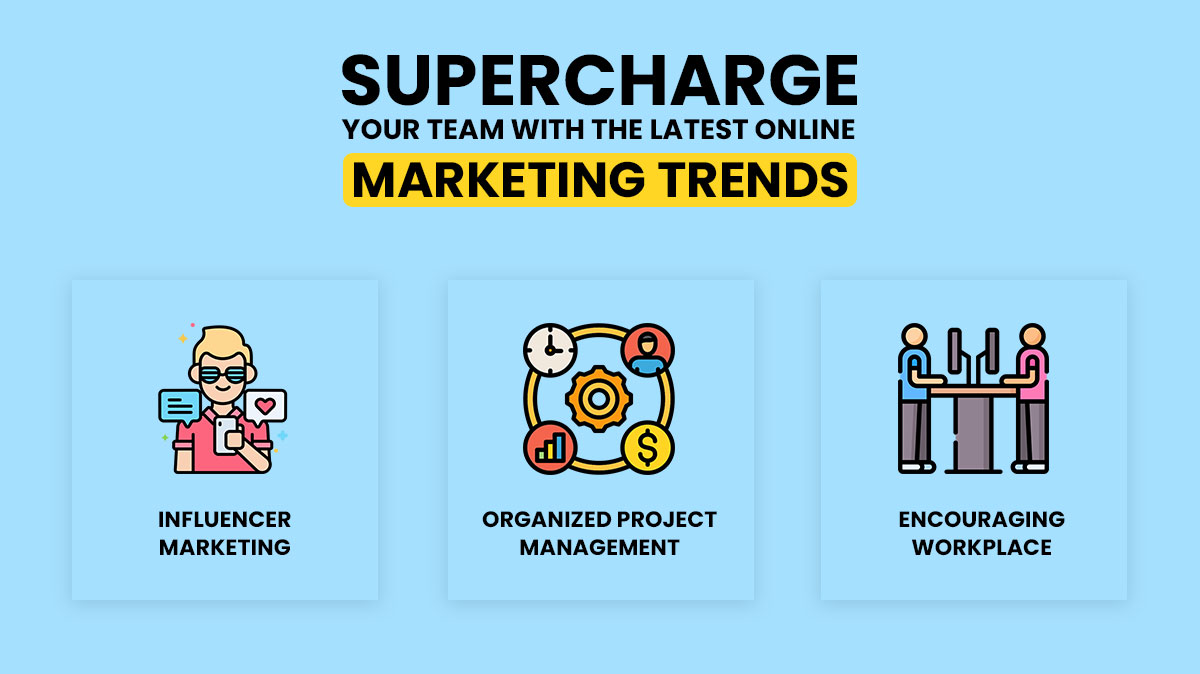
1. Influencer Marketing

Social media has increased in popularity more than any other medium in the past few days. Influencer marketing is an effective medium in the present world of eCommerce marketing world. Prominent influencers with a good target base and market standing can boost a business tremendously. Hence, your teams must learn how to approach and work with the new-age digital influencers.

2. Organized Project Management

The projects have become much more organized with new task management tools and applications. You can offer training sessions to your teams and ensure that they use the task organization and project management tools for much better efficiency.

3. Encouraging Workplace

Very often, workplace expectations keep changing in modern times where most employees are only interested in developing their careers and adding more value to their professional lives. You can make your team members considerably valuable by offering them online marketing training programs.

In the present digital transformation world, it has become absolutely important to upskill your digital marketing team while planning and implementing a competitive marketing strategy that can help you stay ahead of your competitors. 

You can upskill your employer base by enabling them to improve their ethics, approaches, and fluency. In addition, you can also learn about the importance of working together as a team with effective collaborations. The upskilling programs help in improving a team’s productivity, boosting employee performance, increasing employee retention rate, and helping team players learn their strengths.

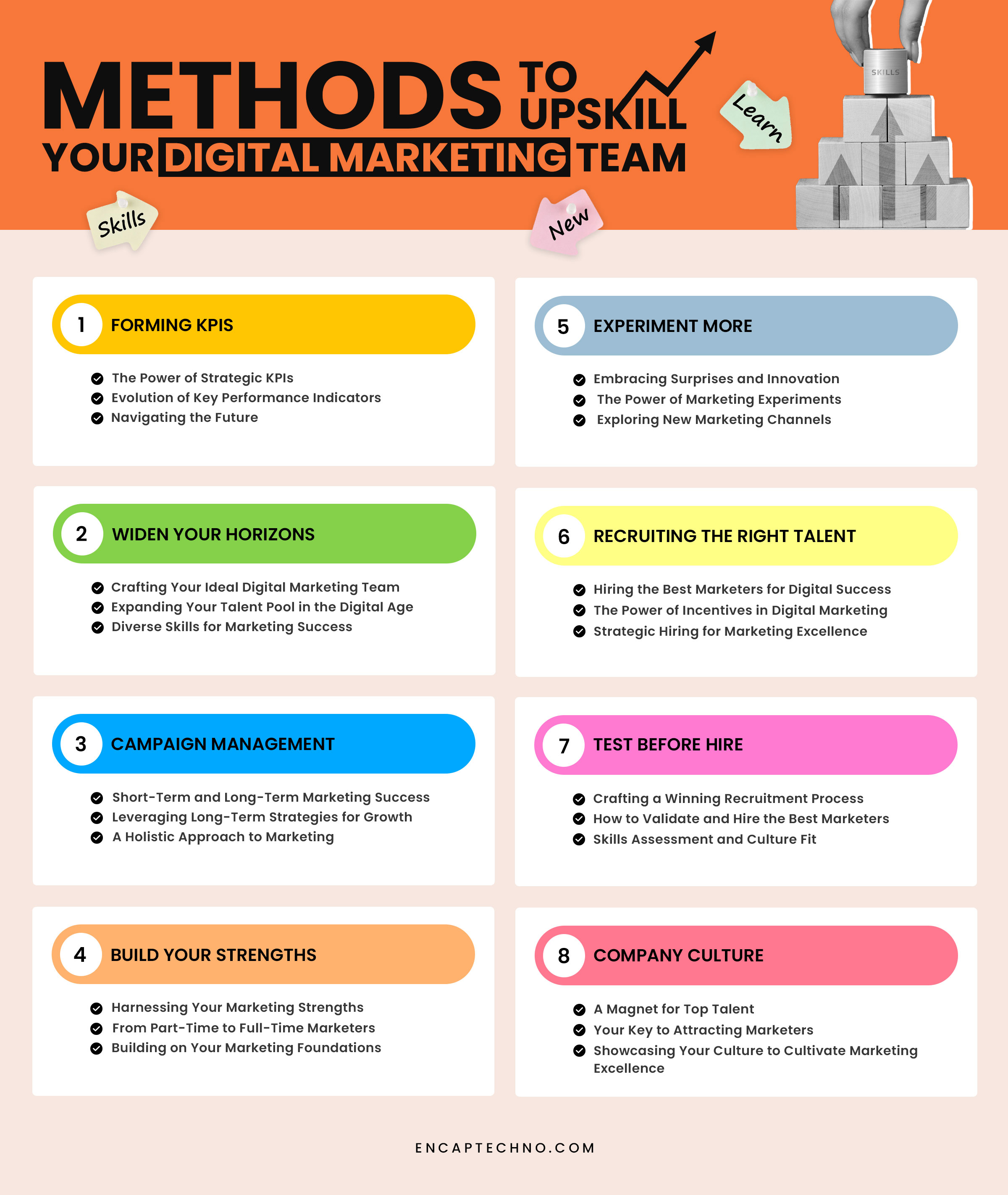
Methods to Upskill Your Digital Marketing Team
Methods to Upskill Your Digital Marketing Team

1. Forming KPIs

It is absolutely essential to establish the right KPIs as technology allows companies to track data regardless of whether they are interested in finding more about click rates, bounce rates, or customer lifetime value. 

In case you are serious about improving your marketing team then it may be the right time to start thinking about new ways that can contribute to your future success. If your company is offering a free trial but you are not able to convert website visitors then it might be the right time to take a better look at your landing page or feature unique benefits prominently. 

It may also be the time for your business to begin looking at important KPIs while you scale. You can establish many critical KPIs and also focus on improving them if you seriously want to build your marketing team. In addition, you can establish new KPI time frames including moving from one way of doing things to another way.

You can also contemplate the kind of KPIs that may be outdated. The KPIs must be replaced with improved ones that can measure marketing success because once they are established you can focus on improving them. 

This is a consistently developing process as some KPIs might prove to be way more important in the future as compared to others. Suitable changes can be made accordingly for achieving desired results. 

2. Widen Your Horizons

There are many digital marketers but you must be clear about the kind of professionals you want to hire. Think about the personality traits in addition to the skills that you may be looking for in a professional and do not be limited to hiring these professionals outside of your city, state, or even country. 

The remote working boon of some years has managed to allow marketers to work from home while travelling while opening up employee pools for companies that are willing to hire remote working staff. 

Organizations of all kinds and sizes are already in a place to hire more remote workers from all over the world. Many companies might also consider hiring individuals that are different from typical marketers for adding to a marketing team.

A journalist or a media professional might just be able to land your organization in a high-profile publication. In a similar way, someone who may be interested in design may also be able to contribute to an overall marketing strategy. 

3. Campaign Management

All organizations have to consider short-term and long-term marketing campaigns. The short-term marketing campaign may involve things such as good blogs and current events and trends. 

On the other hand, long-term marketing campaigns may be good for content strategy and improve SEO rankings in the coming time. A company should be able to balance all kinds of campaigns to become more successful. 

Many businesses can take action for increasing traffic by involving influencers to endorse their business or a post about a company that eventually ends up doing well on the internet. The focus should be on long-term strategies to offer a foundation for more leads and revenue in the future.

Ideally, short-term marketing campaigns should create sufficient cash flow for funding long-term campaigns. Long-term campaigns can be important for building a brand and it can be great to spend time on a good marketing strategy but also provide a solid base for future revenue.

4. Build Your Strengths

A business may have a good amount of information about what it is doing well and what is not. For instance, data may suggest that a landing page is sending a clear message about a product or a service. There might also be some blog content that can perform well when it comes to explaining benefits. 

In case you know what is working then it is important to double on that strength. In case you have taken a decision to hire a content marketer and see that there is more return on investment than you had assumed then you can think of a plan that can work about ramping up the campaign. 

On the other hand, if you have hired a marketer part-time then it might be the time for you to offer a full-time position to them. It can be worthwhile to hire more marketers if this approach works well for you. If you have always had substantial website traffic and email marketing then you can build on this and ensure that the numbers improve. 

The best part of building on your strengths is that it can take lesser time and effort because the efforts work well and the team can focus on changing and optimizing the plan. In case it is working then it makes sense to commit completely to the overall marketing strategy. 

5. Experiment More

There is no specific rule book for marketing. In fact, there can be many surprising trends that can actually end up surprising marketers globally. A key to marketing is to try new things while also remaining loyal to your brand. 

Make sure that your digital marketing team is never afraid to try more experimental campaigns that can end up offering insight even when they are not as successful. Most marketing experiments can create data that tell you specific things about customers that you do not realize. 

You may just figure out why a brand is perceived a specific way or even find that a target customer has a different persona than you initially thought. Sometimes you can also discover more about new marketing channels that your customers prefer that can help in informing a future ad campaign.

Sometimes you may discover that one social media platform is much better than a marketing channel for your company or a podcast may end up generating many leads in the future. You can actually devote a specific percentage of your budget to experimentation so that the results can lead to better marketing decisions. 

Successful marketing campaigns involve considerable work and a good risk as well. Hence, the digital marketing team must be working on new ideas and testing concepts to figure out what can be improved, why it works, and how it applies.

6. Recruiting the Right Talent

In case you are interested in taking digital marketing seriously then you cannot just hire anybody. It actually takes some time, effort, and money to find good teams. Excellent results are only possible when you hire the best marketers.

You must be focused on going out of your way to provide the best incentives to people because that will help attract the best talent. In case your team is not contributing properly then it may be time for you to think about posting then you can start posting specific job roles for marketers.

7. Test Before Hire

If you want to hire the best digital marketing team then you should also have the right hiring and recruiting process. This may include many interviews for finding if the staff fits in your company culture while also reviewing the portfolio and asking for proof that the marketing ideas lead to cash flow. 

Furthermore, it is also necessary to ensure that the candidates are qualified just as they say they are. You can test their skills to make sure that they completely understand the importance of taking the right decisions when it comes to marketing campaigns. This helps in offering peace of mind and technical skills required for growth.

8. Company Culture

A fact about the modern job market is that multiple candidates are attracted to companies only because of the company culture that they offer. Some organizations can attract the best talent because they stand by specific reasons like diversity, transparency, and sustainability. 

Your business must go out of its way to make sure that it helps companies build a culture that attracts the best marketers. The website can clarify your company culture too because it enables you to feature content that elaborates on company beliefs and principles. You can feature specific positions and optimize the application process for convenience.

Related Read: A Detailed Guide to Marketing Automation

Conclusion

Upskilling your digital marketing team can benefit your business and also give your employees the message that you genuinely care for them. You can focus on self-growth and development while finding innovative ways to grow and succeed in the coming years. Hence, it is best to invest in employee training and upskilling your team. Get in touch with us to discover how we can support your team’s journey towards excellence in the dynamic digital landscape.

8 Ways to Upskill Your Digital Marketing Team Read More »

Digital Marketing, , ,

Google Ads Quality Score

7 Ways to Improve Your Google Ads Quality Score

If you didn’t know this already then you should know that Google Ads can call out your rating quality score. Google uses a tool for finding how the ads can affect the overall user experience when they are measured against certain keywords. 

Google Ads Quality Score

When digital marketers use quality scores, they can find which parts of their marketing campaign must be improved and hence how can the Google Ad Quality Score be improved. In addition, it also gives a better sense of how well an ad quality can be compared to other advertisers. 

A higher quality score means that an ad and a landing page are much more relevant and useful to search queries. There are useful methods by which the Google Ad quality score can be improved. In this blog, we will see 7 ways to improve the Google Ad quality score. 

If you are into digital marketing or the owner of a business and wish to learn more about improving your ad experience then keep reading to know more. Let us first begin with what is quality score and how is it calculated.

What is Google Ad Quality Score?

Quality score is essentially a diagnostic tool that is meant to give you a better sense of how an ad’s quality compares to other advertisers. This is a score that can be measured on a scale from 1-10 and is also available at the keyword level. 

A better quality score means that an ad and landing page are relevant and useful to someone who may be looking for a keyword as compared to other advertisers. The quality score diagnostic can be used for identifying where it can be beneficial to improve the ads, landing pages, and keyword selection.

It must be noted that the quality score is a key performance indicator and it should not be optimized or aggregated with the data. It is also not an input in the ad auction but a diagnostic tool for identifying how ads show certain keywords affecting the overall user experience.

What is the Importance of Google Ad Quality Score? 

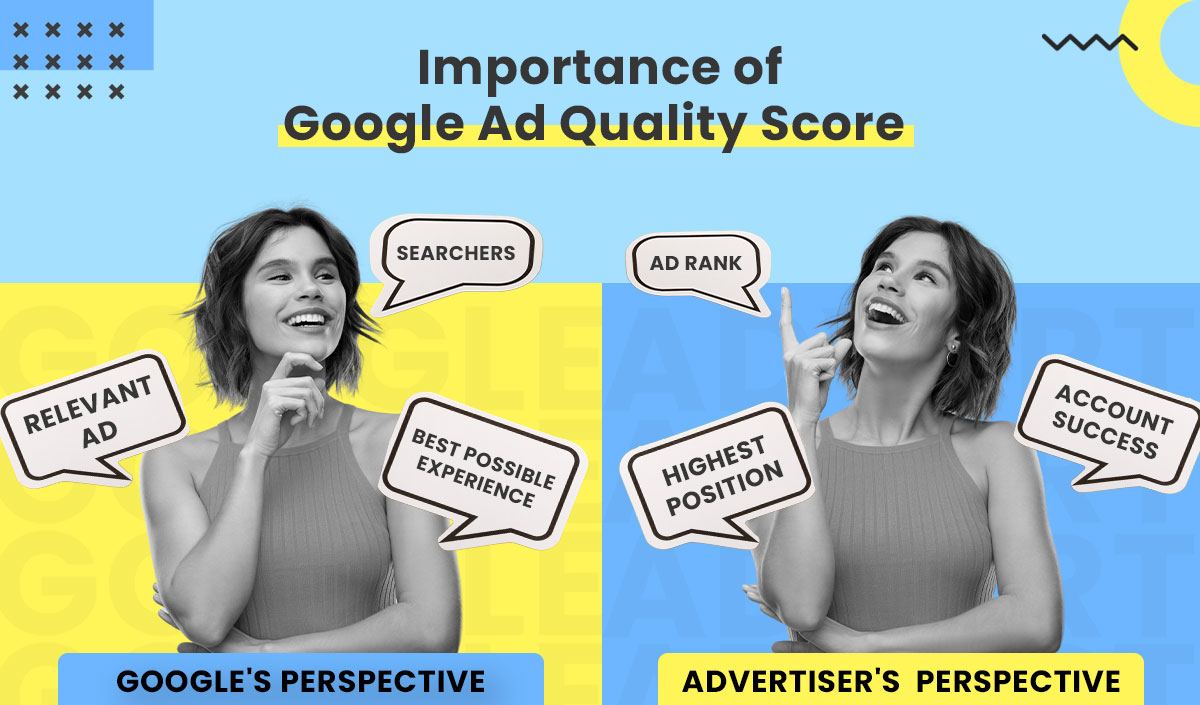
To begin with, it is important to understand that the Quality Score must remain different from key performance metrics. You must not optimize the Quality Score but focus on using it for identifying the areas that require optimization. There are primarily two reasons why the Google Ad Quality Score matters so much. 

  1. From the perspective of Google, the Quality Score is important because it explains to Google how relevant an ad can be. In case Google does not perceive the ad as relevant, the ad might not get served. In addition, Google uses Ads to ensure that they are relevant to the people searching. This is how Google can offer the best possible experience to searchers.
  2. Secondly, if we see the perspective of the advertiser then the Quality Score is important because it determines the success of an account. It is used for finding Ad Rank along with the bid. The advertiser who has the highest Ad Rank will get the highest position. 
What is the Importance of Google Ad Quality Score

The bid and quality scores decide the rank of the ad. Often, the advertiser’s mistake having a high budget with the best ad position and visibility. This also explains why Google Search campaigns have a lower CPC compared to the usual search campaigns while achieving a high ad rank and position as well. 

One of the best moves that you can make is to bid on your brand name. Also, the competitors often struggle to achieve better relevance than you when you bid on the brand terms.

Related Read: Maximize Your PPC Ads ROI with Google Ads Performance Planner

How To Calculate Your Quality Score?

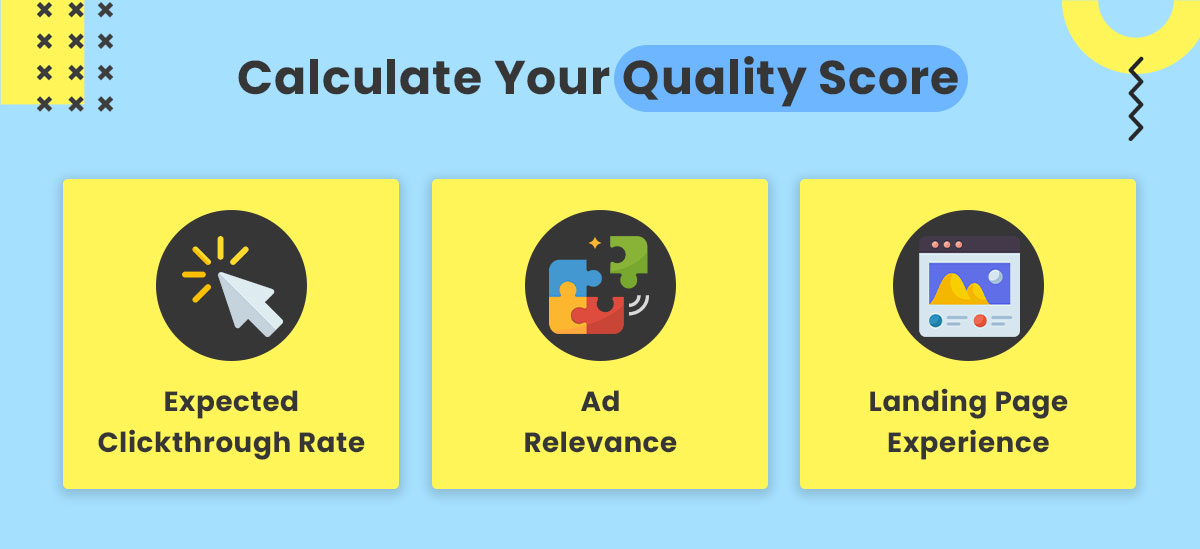
The quality score can be calculated on the combined performance of three components. They are mentioned below. 

  • Expected Clickthrough Rate (CTR) – The likelihood that an ad will be clicked when it is shown.
  • Ad Relevance: The way in which an ad matches the intent behind a user search.
  • Landing Page Experience: How relevant and useful is a landing page to people who click on the ads.
How To Calculate Your Quality Score

All components are evaluated with statuses that belong to three categories – Average, Below Average, and Above Average. The status that an ad belongs will come under comparison with other advertisers whose ads are shown for a similar keyword over the last three months.

In case the ad belongs to Average or Below Average status then it may be time to make some improvements. There are some things to keep in mind when it comes to the Google ad Quality Score. They are:

  1. The Quality Score is dependent on historical importance for searches of a keyword, therefore, changing the keyword match types will not impact the Quality Score.
  2. In case you notice a “-” in the column of Quality Score then it means there are not enough searches that match the keywords for determining a keyword’s Quality Score.
  3. There are factors related to your ad quality that may not be recorded by the Quality Score. These factors commonly include location, time, assets, and devices used in the search.
  4. The information taken from Google’s various crawlers might be used for assessing ad quality which can then be reflected in the Quality Score. 

How Can You Check Your Quality Score?

There are some simple steps for checking the Google quality score. They are mentioned below. 

  1. In the Google Ads account, click on the icon of the campaign. 
  2. Once you have done this, click on the Audience, Keywords, and Content drop-down in the section menu.
  3. Click on Search keywords.
  4. On the upper right corner of the table, click on the “Columns” icon.
  5. Below the “Modify Columns for Keywords”, you can open the Quality Score section. For seeing the current Quality Score and the component status, choose the options such as Quality Score, Landing Page Exp, Exp CTR, Ad Relevance, etc.
  6. You can also see past the Quality Score stats for the reporting period that you may be looking at and choose any metrics from Quality Score, Landing Page Experience (Hist.), Ad Relevance (Hist.), and Exp. CTR. (Hist.).

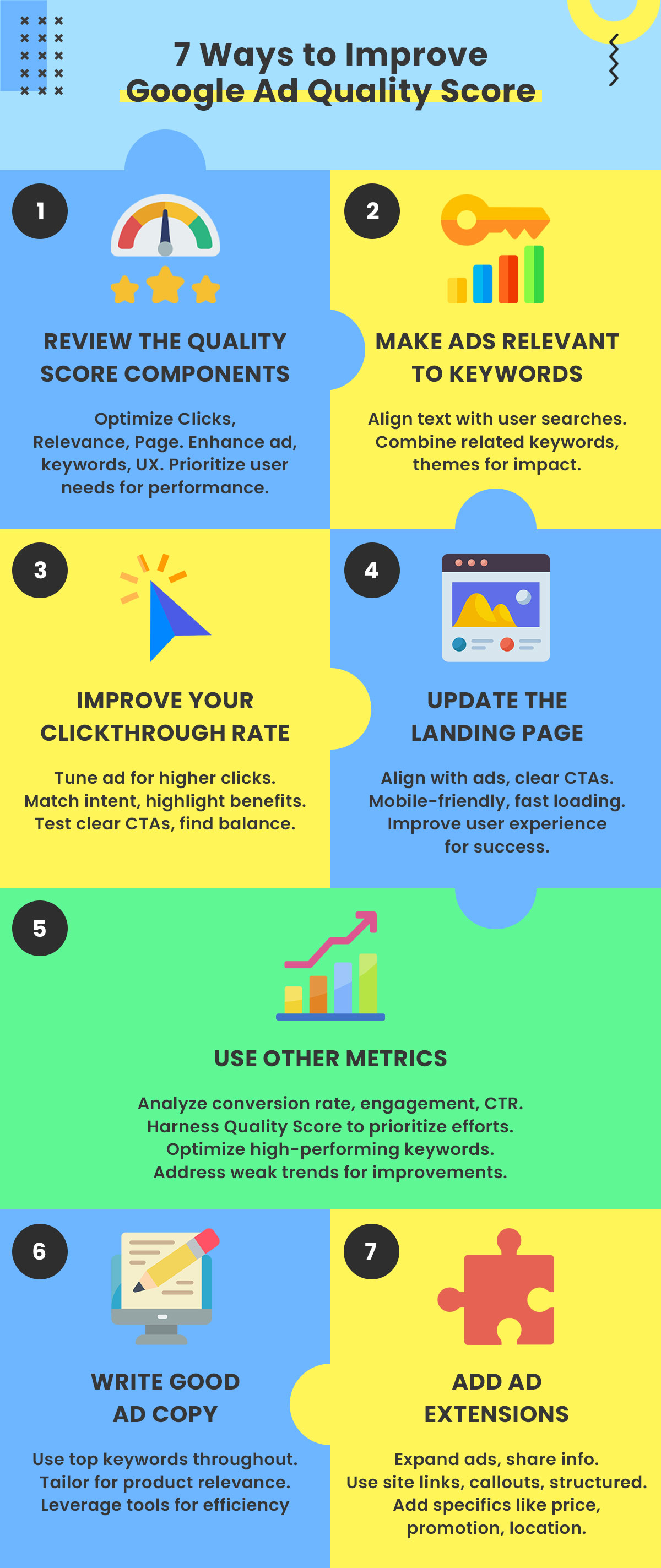
7 Ways For Improving Google Ads Quality Score:

Quality Score is a valuable tool for identifying ways to improve ads, keywords, and landing pages. You can think of a Quality Score as an indicator of which areas should be focused on for improving the ad quality rather than a score that should be optimized. 

In this article, we will help you discover different ways to improve the Google Ad quality score.

1. Review the Quality Score Components

For insights on where you can make improvements, you must go deeper into the three components of the Quality Score. These components are the Expected Clickthrough Rate, Ad Relevance, and Landing Page experience.

Looking into these components can be useful for seeing whether you should update the ad text, keyword selection, or landing page content. In addition, you will also be able to see the status that the ad might belong to (Above Average, Average, or Below Average) for all components to give a better sense of all areas that need improvement.

Optimize Clicks, Relevance, Page. Enhance ad, keywords, and UX. Prioritize user needs for performance. The focus must be on the long-term performance goals and the way in which they can be reached so that eventually the user experience can be improved as a diagnostic tool. 

2. Make Ads Relevant to Keywords

The ad relevance may show how relevant your ad can be to the keywords that are being targeted. If the ad relevance has a status of being Below Average or Average then you should try the best practices such as matching the language of ad text directly to user search terms. 

You can look for ad groups with different types of keywords that can be easily addressed by the same ad and even split the ad groups that match the searches made by the user. You can also try grouping the keywords into themes to increase overall relevance. 

The themes can be based on products, services, and other different categories. For instance, if you offer Software Development services then you can have a group of keywords for “Software development services”, “Software development”, etc.

3. Improve Your Clickthrough Rate (CTR)

The expected clickthrough rate shows how likely people are to click on your ad. In case the expected click-through rate does have a status of being below average or average then there are some practices that you can follow. 

You can edit your text to make an offer more compelling to a specific audience. Make sure that the details in the ad match the intent of the keywords. Go ahead and highlight the benefits of a product or a service that you are offering. 

It can also help to experiment with different call-to-action buttons that can connect closely with a landing page. Create a compelling call to action button with words such as “Buy, Sell, Browse, Find, Sign Up, Get a Quote.” Make sure that you are specific in the ad text. 

There can be times when a specific ad leads to lower CTRs but sometimes higher conversion rates. Your attempt should be to maintain a balance that leads to the best performance for all your goals. 

7 Ways to Improve Your Google Ads Quality Score

4. Update the Landing Page

You can bring people to a site and offer them a great experience on the website. In case the landing page has a status of average or below average then you can try to update the landing page. 

Try to give people what they may be looking for. In case someone looks up “Zoho CRM Consultation” and also clicks the ad for “Zoho CRM Consultation” the landing page must feature the benefits of this consultation.

You must keep messaging consistently from ads to landing pages. Also, make sure that the page follows through on the ad’s offer or call to action button. Even if you have no control over the site, you can still experiment to look for useful existing pages.

You can use conversion rates to ensure a good landing page experience. This does not impact the landing page status but it ensures that the landing page gets measured and optimised. Your effort should be to make a website mobile-friendly because ease of navigation is something that users value more. 

There is a Mobile Friendly Test by Google that helps in seeing the landing page working on mobile devices. You can also be focused on improving the loading speed as that decides the difference between someone buying something or just bouncing off the page.

5. Use Other Metrics

Make an effort to look at other metrics in the account such as conversion rate, site engagement, and clickthrough rate. They can be connected to the performance and also help as you keep looking for areas that must be improved.

When you see your performance, you can also use the Quality Score as a filter for understanding where your efforts must be focused. You can look through high-performing keywords and also use Quality Score to identify which ones might do better with changes to ads and landing pages. 

You can use low-quality scores and component status to find weaker trends for ad relevance, landing page experience, and a clickthrough rate that may exist on an account, and set long-term plans for improvements.

6. Write Good Ad Copy

You should have relevant ad copy that includes the best-performing keywords in an ad group in the headline, description, and URL. It is necessary that the ad does not look robotic and actually sounds compelling. 

It is best to follow the previous step and write a relevant ad copy that includes some of the best-performing keywords in the ad group. Create a tailored ad copy for all of the products to increase the ad relevance. On the better side of things, there are tools that can be useful for reaching your goals.

The ad creation builder helps in combining product information and adding static text to the combination. The advertiser uses product name, brand, and product price to build a universal ad pattern.

7. Add Ad Extensions

Even though ad extensions don’t necessarily affect the Quality Score, they have always helped in increasing the CTR. Ad extensions are an effective way of expanding an ad. They can increase the amount of space that an ad uses in search engine and gives additional information about a business. 

The CTR and expected click-through rate benefit from including many relevant ad extensions. Site links, callouts, and structured extensions are important to all businesses and must be included. Addition ad extensions are extremely relevant where they are about price, promotion, or location. 

Related Read: 8 Ways Google Ads Can Improve Your SEO Results

Embark on the Journey

The above-mentioned ways are effective for increasing the Google Ad Quality Score and also impact overall results. You can actually improve the ad experience, and landing page experience and also achieve a higher CTR that helps in seeing an increase in Ad Rank.

Ready to amplify your google ads

In case you need any more assistance in the implementation of these methods with our expert Digital Consultants who have a firm knowledge of all ways that can improve Google Ad Quality Score. 

7 Ways to Improve Your Google Ads Quality Score Read More »

Google Ads, Digital Marketing, , ,
What is Real-Time Marketing and How Does It Help?

What is Real-Time Marketing and How Does It Help?

Real-time marketing is a concept that is focused on events, customer feedback, and trends on social media channels for the purpose of creating relevant interactions with the target audience. The key ingredient of these interactions is that they happen in real-time.  

What is Real-Time Marketing and How Does It Help?

Marketers listen to the needs of customers through various listening tools that ultimately help in connecting prospects and customers, convey the brand’s position, and drive conversions. In this blog, we will try to understand why real-time marketing is important and also offer a detailed explanation of strategies. In addition, we will also offer examples of real-time marketing.

What is Real-Time Marketing?

Real-time marketing means reacting in real, near, or real-time. It is essentially about creating relevant messaging and it is achieved by listening to the needs of customers. In essence, real-time marketing is focused on current events, trends, and feedback. This marketing happens when a company reacts instead of planning and strategizing a marketing plan for months. It does not mean that you’ll have a real-time marketing plan but there will be a quicker turnaround.

The objective is to connect with the audience and communicate the brand position effectively. You may be able to plan real-time marketing in case there’s an event or an ongoing trend. For instance, if you plan around an ongoing trend, your company might become appealing to your audience because you understand them more.

Real-time marketing offers relevant messaging that is tailored to the wants, interests, and needs of the audience. An effective way for marketers to implement a real-time marketing strategy is to ensure an active social media presence. The social media you have will often be the first to know about a current fad or if they are implementing social listening.

You can also learn more about your audience and their present interests by focusing on your own. See your website and social media analytics to discover the most popular conversation. You can also learn the questions that your audience is asking with social listening tools. In case there is a team that is actively looking at this information then it becomes easy to develop a marketing plan. 

Anytime you want to implement a real-time marketing plan, you must listen to your audience, monitor all industry trends, and know where the conversation is taking place. After this, you must react to your audience on social media and also create assets to know what is going on.

How Do Marketers Work With Real-Time Marketing?

marketing is delivering the right data at the right time and to the right systems for connecting better with the customers. The right time is doing what is required to make every moment count for the customers and real-time is collecting the data while making no delays. When marketers say real-time, what they really mean is right-time. The meaning of real-time 

The single reason for making this distinction is that there can be significant technical and organizational costs to imposing real-time requirements on the marketing teams. Some teams do have the resources to handle it and sometimes they don’t.

It is necessary to make strategic investments into the systems that need to be real-time so that the personalization platform and customer data platform can understand what is required elsewhere. You can set the real-time data priorities on the basis of “Respond” and “Inspire.”

In many cases, it is the “Respond” mode that needs you to address customer concerns quickly. On the other hand, many “Inspire” activities are pre-planned and also benefit from the complete data that does not require any hyper-warp speed investment. In many cases, real-time responses can become counterproductive. For instance, think of an abandoned cart email. Not many people react calmly to a reminder email or even worse, a text message and this is what is meant by real-time marketing. 

Why Real-Time Marketing? 

Organizations can connect with their target audience in real time by acting on a marketing plan. It is simple to connect with leads and educate them about a product by interacting with potential customers in real-time when they need recommendations and assistance. Marketers can use social media channels for identifying customer needs and addressing them quickly. 

People who receive instant support in direct messages, comments, and recommendations can appreciate brands and also show trust. Real-time marketing can be used to create relevant messaging and engage in appropriate communication with your target audience for meeting needs, wants, and desires. 

It is possible to offer relevant and timely solutions to the problems of your prospects. In addition, you can also ensure an active social media presence enables companies to communicate with the audience and convey their brand positioning. This encourages brand awareness and also builds relationships with customers. You can also plan your response to an ongoing event so that you become appealing to customers and understand your pressing issues.

Real-time marketing campaigns enable businesses to become relevant and respond to the latest news and things in the world. With their support, brands can pay attention to people’s words and also address the problems in real-time. 


Related Read: Rising Customer Engagement Trends in the Market

What Can Be Done With a CDP Using Real-Time Data?

While you are making final decisions based on real-time data, you can effectively respond to customers while also upgrading your Customer Data Platform (CDP) just to make sure that you have all the answers your customers want when they want them.

When you do this, you do not just make for happy customers but also improve the bottom line in an affordable manner. This is how real-time marketing ensures that you meet your needs timely. For instance, a customer may make a purchase on an e-commerce website that puts them into a high-value segment which can trigger right away into a journey tailored to high-value customers.

Salesforce has launched Data Cloud, a new CDP platform that uses real-time data for making marketing easy for companies. It is a platform that helps in improving customer journeys. Anyone considering a CDP for supporting real-time data management must ask how well it supports the right time requirements. 

Having parts of the customer journey happen in real time might not be enough. Confusion about what is and what is not can fade when you have an answer to the requirements of customers.

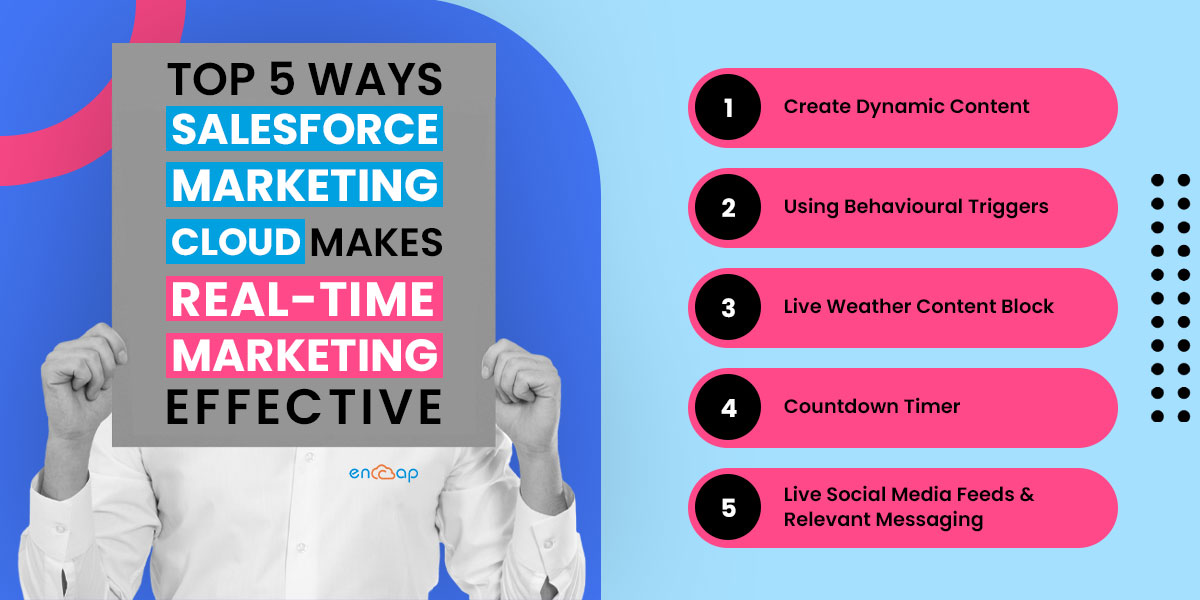
Ways In Which Salesforce Marketing Cloud Makes Real-Time Marketing Effective?

Real-time marketing campaigns are an effective way to delight customers and also increase open click-through rates. However, implementing these campaigns can be challenging with other ESPs. The Salesforce Marketing Cloud makes it easy for markets to interact with their subscribers with real-time emails and also provides enhanced experiences.

On the other hand, SFMC email marketing enables markets to have better access to a wide range of content tools for personalizing emails on the basis of different metrics. These often include real-time countdown timers to drive actions, personalized images to improve engagement, and dynamic web crops for seamlessly integrating the latest offers and blog posts into emails.

1. Create Dynamic Content


An important ingredient of real-time marketing involves the creation of dynamic content that can be instantly adjusted to dynamically personalize all emails for recipients. With so many Salesforce email templates, you can react quickly to the needs of subscribers with personalized emails that can promote meaningful engagements. 

There are also real-time banners that keep subscribers engaged for a long by showing them offers that can spark their interest. An effective way to move them towards a sale is by tailoring the banner to preferred categories and brands. A good way to ensure that you include the current banners as open-time email content is to use a technology called “Webcrop.”

Other than this, you can also show some product recommendations because when the suggestions do not meet their needs, shoppers get frustrated and tend to leave sometimes. You can display products that can match the preferences of all subscribers and behaviors. An open-time inventory and pricing data ensures that the current offers and coupons are seen and not expired.

Finally, you can also offer product live prices and availability information. By updating the pricing and availability information, you can automatically at the time of each open or view ensure that you never promote any out-of-date content. This works for new emails and abandoned cart emails.

2. Using Behavioural Triggers

While using Salesforce Marketing Cloud, a behavioral trigger is an action that is taken by an individual subscriber. You can use trigger data for implementing real-time marketing and sending customized triggered emails easily. It helps in creating granular segments based on customer behavior and lifecycle stage for delivering a person-to-person experience at scale.

All the triggered emails in Salesforce Marketing Cloud are trackable, targeted, and sent in real-time. They help in offering a better customer experience with price drops and back-in-stock alerts. You can also use auto forward and auto reply with messages processed by Reply Mail Management. This helps in achieving high deliverability and scalability.

To ensure that you get the best results, also make sure that your triggered emails include at least some of the elements such as product recommendations, contextual dynamic images, countdown timer, ratings, and popularity messages. 

Top 5 Ways Salesforce Marketing Cloud Makes Real-Time Marketing Effective

3. Live Weather Content Block

The SFMC also allows the inclusion of a live weather channel block for personalized images based on local weather conditions to appear when a subscriber opens an email. 

When you use the local weather conditions, you can easily curate what is relevant for the subscribers while driving traffic to a store or a website. Using a Live Weather Content Block can be useful for creating emails with attractive images of sandy beaches and sunshine. 

4. Countdown Timer

A countdown timer is like an animated clock that can be inserted in an email message. This clock can be used for counting down important deadlines such as the end of a promotion, or time left for renewing a subscription, etc. for building excitement and creating a sense of urgency.

The goal of a countdown timer is to encourage the subscriber towards taking an action without pushing anything at all. This messaging in an email can be personalized based on the event or for the individual subscriber. 

5. Live Social Media Feeds and Relevant Messaging

Most of the global population now uses social media. If a brand has a social media presence already and you are looking to encourage omni-channel engagement then combining the SFMC email marketing with social media can be effective.

You should keep customers updated and engaged by displaying the latest content from social pages in emails and e-commerce stores. You can include live streams of high-quality user-generated content including product ratings and reviews from various platforms for making your shoppers included. The popularity and scarcity messages encourage the purchase and discourage cart abandonment. 


Related Read: Leverage Marketing With Salesforce Marketing Cloud

Personalize Your Marketing Strategies & Connect with Customers at Scale

Real-time email marketing offers brands multiple opportunities to offer timely and personalized content recipients love. Salesforce Marketing Cloud offers robust functionalities for email marketing automation, triggered campaigns, dynamic content, hyper-personalization, and more. Email marketers have everything they need to implement real-time email marketing quickly. 

Using these features, it is possible to focus on personal, relevant, and timely messages for improving email performance and motivate subscribers to take action. In case you haven’t already, you can upgrade your customer data platform to one that works on real-time data while saving time and optimizing your spending. 

Personalize your marketing strategies and connect with customers quickly using the right technology and implementing Salesforce Marketing Cloud

Personalize Your Marketing Strategies & Connect with Customers at Scale

What is Real-Time Marketing and How Does It Help? Read More »

Digital Marketing, , , ,
Mastering B2B Marketing Strategy: Best Practices and Proven Techniques

Mastering B2B Marketing Strategy: Best Practices and Proven Techniques

Marketing is a fun and interesting practice. Contrary to the common belief of the term B2B marketing strategy is a complex or technical concept, it is actually pretty fun. A good marketing plan can lead to great outcomes for a business. 

Boosting Your Brand: Top B2B Marketing Strategies

What’s best is that there is no one size fits all approach to developing and implementing a marketing plan. That said, there is one distinction that is key while developing a marketing plan and that lies in the fact whether the business is B2B or B2C. 

In this post, we will try and look at all effective B2B marketing strategies required for making a brand successful. Keep reading to know more. 

What is B2B Marketing?

B2B marketing is any kind of marketing plan or content strategy that is designed for making a business or an organization successful. Companies that sell products or services to other businesses use B2B marketing strategies. 

The fundamental purpose of B2B marketing is to make other businesses familiar with a brand name, and the value of a product or a service, and finally convert them into customers. B2B marketing revolves extensively around understanding the journey of a buyer, identifying the target market and audience, creating a marketing plan, and implementing it. 

Marketing For B2B Vs. Marketing For B2C

It is a common viewpoint that marketing to a business can be different than marketing to a consumer and this is true for many reasons. However, it is also true that regardless of whatever business you may have, you are always speaking to human beings. This is the fundamental element when it comes to creating a marketing plan. 

Marketing For B2B Vs. Marketing For B2C:

The difference is that according to the nature of a product or a service, people may have different mindsets. Many marketing strategies can be adopted on the basis of industry, the size of the business, the target audience, their likes and preferences, etc. That said, there are some strategies that work well regardless. 

In this blog, we will look at the B2B marketing strategies for your brand in particular. If you run a B2B brand then keep knowing more about what you should be doing to succeed in marketing.

The B2B Landscape and Sales-Focused Marketing

In the ongoing B2B market, sales-focused marketing strategies should adapt for meeting the growing expectations of the buyers. All B2B buyers are common people which basically means that the buyer journey is about their experiences and product offerings. 

As a matter of fact, a B2B purchasing decision involves considering multiple things. The stakes can often be high and even the investments. This also means that the buyer’s reputation, trustworthiness, and future success are all important factors. 

It is very important to have a strong understanding of sales-driven tactics to make sure that the marketing is on-point. The B2B marketers must be clear about what the buyer wants to see and hear while prompting their products and services.

Why are Sales-Driven Tactics Important?

It is important to create marketing campaigns that attract the attention of the audience and understands their pain points and emotions. The plan must be able to strike a perfect leveling between the informative and emotive aspects. An effective way to make this happen is by sharing the customer stories. 

B2B marketers can consider sharing testimonials that can directly respond to the questions customers may have during the purchasing process. It makes sense to analyze the target audience and be aware of all the concerns that need to be addressed.

For instance, if the prospects care about ease of use then it makes to share a testimonial that relates to that. If the prospects are asking more questions about implementation, one can post reviews of a business successfully implementing the product. 

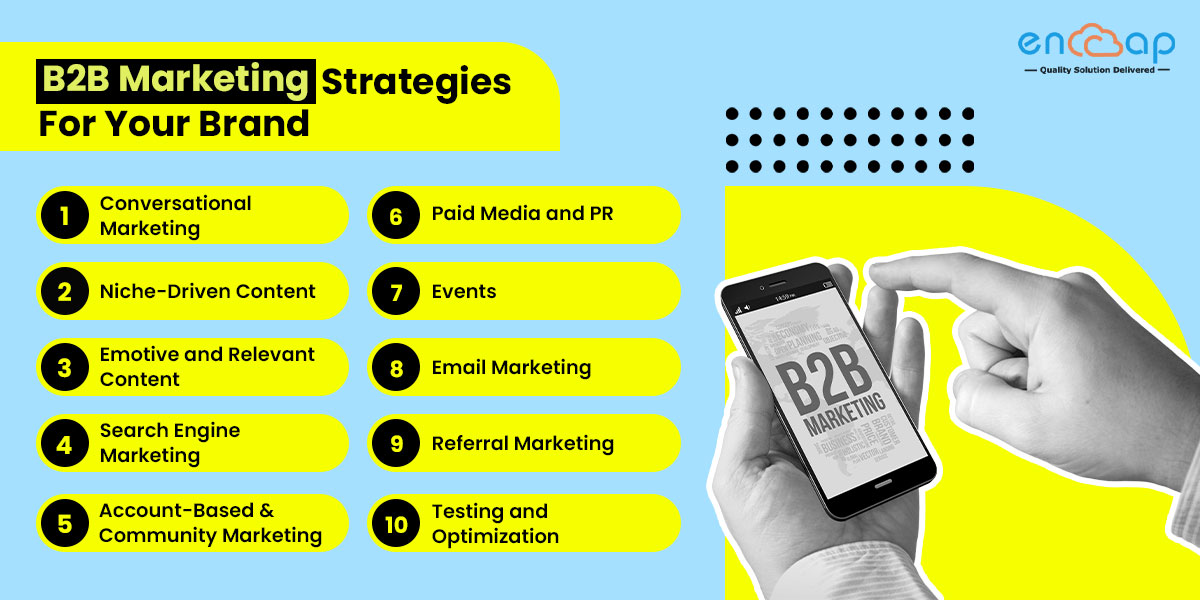
B2B Marketing Strategy: Exploring Key Approaches and Effective Tactics for Success

1. Conversational Marketing

When it comes to prioritizing the marketing efforts that can lead to sales, it is important that you start speaking the language of your prospects. B2B marketers must use a conversational style of marketing for giving prospects quick information which can then speed up the purchase cycle.

The conversations that hold the attention of a community should be based on online behavior which can be tracked by analytic tools. To ensure a profitable marketing campaign, more and more companies must think about the kinds of content that work best to keep brands at the top. 

It is necessary to form a good impression and reach the audience at the right place and time. Most B2B decision-makers conduct business research during the evening or over the weekend. Mostly, they scroll social media, focus on staying connected, and read things that gain their interest. 

2. Niche-Driven Content

An important business consideration is specializing and niche targeting. The research has shown repeatedly that the fastest-growing companies tend to be specialists in a carefully targeted niche.

Hence, the areas of industries should be understood carefully so that you can become a leader in your industry. Specialization makes marketing efforts easy because it tends to define exactly what is needed to be done immediately to differentiate from the competition. A specialization is essentially a differentiator that can prove itself successfully.

3. Emotive and Relevant Content

Understanding emotive aspects of B2B purchasing decisions and aligning marketing efforts accordingly is important for attracting the attention of decision-makers. 

For engaging the target market effectively, it is important to analyze activity patterns and find optimal times for dropping meaningful content. Relevant content ensures that long-term relationships are fostered and there is a better chance of successful business outcomes. Moreover, the messaging should also resonate with the needs and aspirations of customers and ignite their interest. 

4. Search Engine Marketing

Search engine marketing is mostly about running ads and promotional material on the search engine results page and on third-party websites.

Using search engine marketing, it can become easy to achieve a wide range of goals including generating awareness, business traffic, getting more leads, and running seasonal offers, discounts, and giveaways. 

5. Account-Based and Community Marketing

Most B2B companies have Account Managers who build and maintain relationships with high-value customers. The fundamental nature of B2B structures enables companies to build user communities and networks so that it becomes easy to send targeted promotions to groups.

The common activities that form a part of this include processes such as cross-selling, upselling, and media engagement. It must be remembered that for succeeding in marketing, one must ensure offering consistently high-quality support. There might even be a requirement for resources to ensure prior support.

Top B2B Marketing Strategies For Your Brand

6. Paid Media and PR

Most B2B companies have the ability to establish media relationships that can promote businesses. This commonly includes talking to journalists and securing mentions in renowned mainstream media including newspapers, television, and online magazines. 

Paid media is an outbound marketing activity and because of its persistent expenses, it is ideal for businesses that have a strong reputation or the resources required for investing in media. 

7. Events

On the basis of how one approaches events, developing a strategy can be expensive. In case you are a big company with a global presence then it can be helpful to consider hosting physical or remote events across the world or enabling local communities to run events.

It can also be helpful to attend business conferences that showcase your offerings. Event marketing can go until running workshops, round table conversations, webinars, and seminars both online and offline. It is best to find the balance so that you can effectively manage your budget efficiently and also reach a wide audience.

8. Email Marketing

Email Marketing is one of the most essential marketing strategies for B2B businesses. It does not just help you stay in touch and update your existing customers but also allows issuing email newsletters and converting high-quality leads.

Making a developed email marketing plan can help B2B businesses do really well in the long term. It helps the business to ensure that its customers are being targeted at the right time and in professional ways. 

Suggested Reading: Zoho Campaigns: An Outstanding Email Marketing Tool

9. Referral Marketing

The simple nature of professional services has changed tremendously but this has major effects on the B2B marketing plan. A referral marketing plan signifies important facets of receiving referrals from someone who may not be a client earlier. 

The referrals come from a wide number of firms that have a reputation for specific expertise. Content planning and marketing along with other tactics can help in building a brand that has a widespread reputation for an area specialty. 

Moreover, B2B marketers should also have expertise amongst audiences that may not have worked with the customers directly. Brand recognition can lead to new referrals and businesses also. 

10. Testing and Optimization

Testing and optimization are two processes that enable marketers to iterate their marketing efforts and make future decisions on the basis of hard data as opposed to their intuition. 

As research is the bedrock of marketing, testing, and optimization is your continuous guide. You must never put an end to your marketing campaigns and adjust them as the need arises. A/B testing of landing pages and emails helps in learning which of two emails or landing pages converts users successfully in language, design, and other variances. 

Related Read : How Is Salesforce Einstein Revolutionizing The B2B Market

Tailor Your Marketing Plan to Your Specific Goals and Target Audience

Tailor Your Marketing Plan to Your Specific Goals and Target Audience

When it comes to marketing a B2B business on your own terms, there are many options that you have to take care of. The key to successful implementation lies in executing your plan while optimizing resource utilization in your business. 

It can be easy to overwhelm yourself by doing everything at one time. You should always know your strengths and limitations so that you can develop a successful marketing plan. All the strategies mentioned above when executed properly can ensure that you become successful. 

Zoho Marketing automation ensures that you do well in B2B and B2C marketing. In case you haven’t already implemented the best features offered by Zoho marketing then you must for getting the benefits that it can offer. Encaptechno has top marketing consultants who offer expert advice. Get in touch to advance your marketing and get more business. 

Mastering B2B Marketing Strategy: Best Practices and Proven Techniques Read More »

Digital Marketing, , ,
How Can Generative AI Help Marketers

How Can Generative AI Help Marketers?

Generative AI has been raising a decent amount of hype lately but with this buzz, there are also many things that need to be clarified on how it can help marketers. As customer expectations rise and personalization becomes an expectation, marketers use Generative AI to maintain customer loyalty and gain insights in a post-cookie world.

How Can Generative AI Help Marketers

AI can help marketers, commerce teams, salespeople, and many more make informed decisions. This scratches the surface of how brands can use AI in marketing for becoming more efficient and productive. When it comes to marketing, the integration of AI has been transformative as well. 

Despite the impressive potential of AI, creativity, and empathy stay important elements of marketing. Modern marketers face the challenge of not just making the most out of the capabilities of AI but also doing that in a way that preserves the critical human aspect of marketing strategies. 

All in all, generative AI can help marketers significantly. In this blog, we will see all the ways in which that is possible. 

What Does Generative AI Look Like For Marketers?

Generative AI can help with creating marketing materials or offering quick solutions to customer reactions and customer experience is just the beginning of what businesses can do with the technology. The combination of generative AI with an intuitive customer data platform can enable companies with the tools required for taking action on real-time insights. It can help in delivering personalization at scale including product recommendations customized to individual customers based on browsing and purchase history. 

Customers also expect brands to use their data for offering relevant services. Most customers expect companies instantly to reach with up-to-date information when it comes to transferring across departments. Generative AI can help customers by giving agents suggested responses created right at the moment on the basis of real-time data. 

Related Read: Automation of Marketing Activities Using Zoho Apps

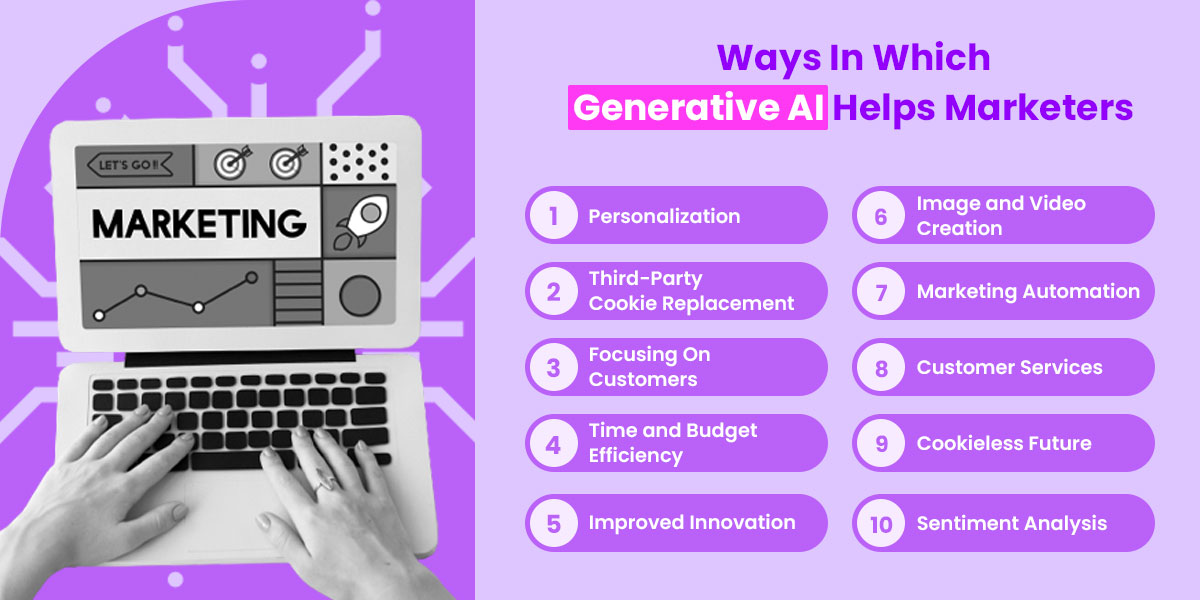
Ways In Which Generative AI Helps Marketers 

1. Personalization

The customers of today expect personalization at each step and mostly they prefer to stay loyal if the company offers them a more customized experience. The combination of Generative AI with CRM data gives marketers the ability to create the kinds of digital experiences that can really help customers. 

In addition, this results in efficient marketing journeys that can be more tailored to the audience across content creation, design, and targeting. 

2. Third-Party Cookie Replacement

Third-party cookie deprecation and easy access to high-quality data that is well structured and useful. This is a growing challenge for marketing organizations. Most business leaders cite a lack of understanding of data because it is complex and not accessible enough. 

With data becoming more and more difficult to collect, store, and analyze, marketers can now turn to AI tools for analyzing the data that they do have and for making the right decisions. AI can help markets process existing and limited first-party data so that rich insights can be provided.

The fact of the matter is that trusted first-party data is important for Generative AI to work well. Most marketers play an important role in the Generative AI success and also claim that human oversight is important for ensuring that a brand’s voice is always authentic.

3. Focusing On Customers

The shift in focus and conversation around Generative AI is important. You can eliminate all confusion and delays in analyzing data as generative AI takes the problems out of content creation. The technology is capable of creating product descriptions that are accurate, compelling, and even optimized for search engines.

Generative AI is also capable of handling low-level tasks as marketers are able to focus on strategic campaigns, and creative campaigns, and also create more connections with customers. As a matter of fact, Generative AI can completely change how marketing departments function while allowing teams to place more focus on customers. 

4. Time and Budget Efficiency

One of the benefits of using Generative AI marketing is increased time and budget efficiency. The overall time devoted to composing marketing materials can be reduced by producing extensive replies within seconds which is quicker than what any human beings can manage.

Unlike most search engines, using Generative AI can evaluate online information to present a concise summary. With marketing automation and automated content creation, generative AI can eliminate any need for manual work while freeing up time for marketers and reducing the budget needed. 

By eliminating human errors and streamlining processes, Generative AI can also help marketers to reduce the amount of time and budget required for some control tasks. 

5. Improved Innovation

Generative AI offers a powerful tool for businesses when it comes to generating innovative and inspirational campaigns. It can help in staying ahead of the curve and also achieve marketing goals by encouraging marketers to explore more ideas by generating creative concepts that may not be obvious by using traditional methods.

You can assist in generating marketing concepts by drawing inspiration from the previous experiences of others with tools such as ChatGPT covering most online databases. It helps businesses to find customer insights which can be used to create marketing campaigns that are relevant.

Ways In Which Generative AI Helps Marketers

6. Image and Video Creation

Generative AI can help in automating image creation with deep learning algorithms and generative adversarial networks. Image creation with the tools can be helpful for marketing in many significant ways. 

It helps in creating realistic images of products for use in online stores, social media platforms and different marketing collaterals. It also helps in developing visual branding of materials such as logos and advertising that is engaging and visually appealing. 

In addition, Generative AI video tools can also be useful for creating high-quality marketing videos and product demo videos that further help in increasing brand awareness and facilitating conversions. 

7. Marketing Automation

Generative AI helps in analyzing large amounts of data and also helps in identifying customer behaviour patterns for helping businesses find SEO-friendly, relevant, and high-performing keywords for digital marketing campaigns. 

It helps in building SEO content and discovering content topics, conducting keyword research, finding useful content titles, grouping search intent, and creating content structure.

8. Customer Services

The entire customer service process can be automated with the use of AI as conversational AI models have proven that they can effectively understand customer questions and respond to them quickly. 

Generative AI is also automating customer service tasks through chatbots and messaging apps that can provide service channels 24/7. Email automation provides quick responses to common customer questions and requests. 

Self-service portals that have also embedded Generative AI capabilities can offer personalized recommendations and solutions to customers based on their history. They offer multilingual support and localization while catering to a large cross-section of society. 

9. Cookieless Future

Cookieless marketing is the future as more and more platforms such as Safari, Google Chrome, Firefox, and Apple are all removing third-party cookies. Marketing professionals may also feel that new limitations can remove the performance of targeted ads but Generative AI can help in this case also.

Generative AI helps significantly with code generation based on natural language input. The common benefits include saving software developers and programmers from laborious tasks such as code optimization, code completion, and bug detection that may otherwise require human intervention.

10. Sentiment Analysis

Generative AI helps in sentiment analysis by creating synthetic text data that can be labelled with different sentiments including positive, negative, or neutral. The synthetic data also helps in training deep learning models for analyzing real-world text data for the sentiment. 

In addition, Generative AI can also help in creating text that is designed to convey a specific sentiment including positive and negative social media posts that can shape public opinion for marketing campaigns. This method can also address the problem of data imbalance in sentiment analysis of user opinions in fields such as customer service. 

Generative AI and Human Expertise For Marketing

The future of marketing is all set to be influenced by Generative AI. With a wide capacity for analyzing huge amounts of data, creating engaging content, offering personalized user experiences, and streamlining repetitive tasks, the potential of AI for scale and efficiency is undeniable. 

With a growing reliance on AI, the human touch does not become entirely redundant. On the other hand, it becomes more important. As we have seen already, building trust, fostering strong connections, understanding contexts, and also ensuring ethical considerations are all human aspects that AI cannot replicate completely. 

Generative AI and Human Expertise For Marketing

AI may be a tool that generates content but it is the human marketer who guides the direction, provides creative insights, and also ensures the final output with the target audience. The balance between AI and human creativity and empathy is important for unlocking new levels of success in marketing. 

Some of the best practices for using Generative AI in marketing include using high-quality data, reviewing and refining content, updating AI models, considering ethical implications, and collaborating effortlessly. 

AI and Human Creativity Change Marketing

There is no doubt that the evolution of technology is making AI take on more roles across marketing while also fuelling more innovation and growth. To make sure that you can use the best of the capabilities of AI, you must first define your objectives and find the areas of a marketing strategy that you can possibly benefit from. 

AI and Human Creativity Change Marketing

You can also take some time to find Generative AI use cases that can improve the efficiency of your marketing programs. Finally, use quality data inputs as AI depends on them for generating important insights and precise predictions. Make sure that you begin with small projects and keep iterating as you learn more about using AI. 

The key to iterating is by starting small, iterating and improving. With this approach, you will be able to gain the most out of AI in marketing. 

Related Read: 6 Business Challenges Marketing Automation Helps In Solving

How Can Generative AI Help Marketers? Read More »

AI, , ,
PPC Competitive Analysis

How To Do a PPC Competitive Analysis?

How To do a PPC Competitive Analysis?

PPC (Pay Per Click) competitor analysis is a significant part of all successful digital marketing campaigns. When you consistently analyze the competition, you can effectively ensure that you target the right keywords, convey the client’s message, and avoid overspending on ads. 

In case the PPC ads do not perform as it was aimed for, it may be because of improper measuring of the competitor ads. You can show your value and expertise by rethinking your online marketing strategy and also giving these ads a much better boost. PPC competitive analysis is something that must be monitored very closely because otherwise, you can miss out on many opportunities when it comes to paid advertising.

In addition to ensuring that the PPC strategy is in line with the goals, it must also be ensured that the PPC competitor analysis is being monitored. You can stay proactive by noticing the ad copy and convincing users to click on the ads. Start by looking at what the competitors may be doing and find the direct or indirect competition by putting your clients in a better position for outranking the ad position. 

In order to make things simple, we will understand how to perform a PPC competitive analysis so that it ensures effective results. Keep reading to know more. 

What is a PPC Competitive Analysis?

Competitor analysis must be an integral part of the agency’s strategy. In case you wish to help your customers get ahead of their competition, you should be able to compare their strengths and weaknesses while determining their points of differences in the market. 

There are many reasons why a PPC competitive analysis is considered important. Let us have a look at them one by one. 

  1. It shows what kind of keywords are being targeted and exactly what amount is being spent. By focusing on these factors, you can find the gaps in your customer’s PPC campaigns which then helps in saving money. 
  2. When you do PPC competitive analysis, you can effectively adjust the marketing benchmarks and recognize more opportunities for improving your customer’s strategy. 
  3. PPC competitive analysis also helps in revealing how to position a business and keep attention on factors such as new trends, changes, and ideas.
  4. A PPC competitive analysis helps in gaining an edge by improving the ad copy and creative strategy. 

Competitive research tells you the story behind why your campaigns must perform the way they must because your competition can affect you. For instance, this process can offer insights into factors such as rising cost per acquisition, loss in impression share, etc.

In case you wish to scale your accounts and also keep them rising then it is important to monitor your competitors consistently. This allows you to monitor changes in the ever-changing digital marketing landscape. 

PPC is like a race in which you must never take your eyes off the road. With quality competitor research you can keep your attention on industry trends, changes in the competition, keywords, etc. It will also allow you to know more opportunities as they come on the scene and track how you rise up the rank. PPC helps in bidding against the auctions and not just businesses that are in the industry. 

Other than this, there are some measurable reasons why PPC competitive analysis can be helpful. 

  1. Marketing Benchmarks: For all marketing channels, you are required to have an understanding of acceptable statistics that can show good results. However, if your competitors are achieving better results then it is time to rethink the marketing benchmarks completely.
  2. Track Industry and Market Trends: Marketing trends keep changing every now and then and these trends affect the market to many different degrees. Hence, the impact of these trends can spile and decline in the coming years. By performing a competitor analysis, you can measure how the market is preparing for trends and adjust the strategies.
  3. Optimise Ad Budget: While going with the new trends is important, you should also be mindful to not waste your money on old strategies. In case you keep an eye on the competitors, you will not waste money by testing the new pay-per-click strategies and learning from their experiences.
  4. Updating Marketing Mix: The digital marketing strategy of your competitor will tell you almost everything that is to know about them and their ideas. Right from news, to product launches, events, and keywords, you can know everything. All of this information can be used for updating the marketing mix and directing the company’s development.
  5. Revise Goals: With the online marketing landscape changing consistently, it may become important to adjust your strategy, marketing, and PPC goals.
  6. Finding Gaps: At the fundamental of a successful marketing strategy, there is a simple idea of looking for a problem and then offering a solution that can fix it. This problem in the market might have great value for the business and could also be helpful in filling the gaps. These gaps can be high-value keywords or popular search terms that may not have wide competition. Finding these gaps in the PPC market requires you to understand what the competitors may be bringing at the front. 

Related Read: 8 Essential Things You Must Know Before Running PPC Ads

Steps to Perform a PPC Competitive Analysis

The pay-per-click activities can be helpful for boosting brand awareness, generating more leads, and driving more traffic. However, PPC marketing can be challenging to get right, particularly when there are so many competitors who are aiming for the same audience. 

Hence, competitive analysis is very important. It helps in understanding the methods used by competitors and learning more about Google Ad Strategies. 

1. Find Your Competitors

With the competitive analysis, the prime step is to know who your competitors are. Even when you are an established company with detailed information on your competition, you must not ignore this step. 

There are new organizations getting into an industry and expanding that can be counted as new competitors. You must use in-house knowledge for finding competitors as your sales and marketing teams will be aware of who is out there. However, if you are looking for some other ways to deal with this then are many tools that can help.

SEMRush is an excellent tool that helps in conducting ad research while Google Ads Auction Insights helps in measuring the ad, bidding strategy, and even the performance of the campaign that is being run against the competitors. 

2. See The PPC Strategy

After you know who you are competing against, it becomes possible to analyze the PPC strategy. You must also look at how advertisers combine their SEO and PPC strategies for covering organic and paid channels. There are many ways in which this can be done. 

  • Keyword Search: In case you have already done a competitive analysis for SEO then it must be simple to know what keywords the competitors may be ranking for. It is worthwhile to do this exercise for PPC as there are terms that you can miss out on for paid advertising. You can use tools such as SEMRush to see which keywords the competitors may be bidding on. It can be worth looking at the volume and CPC for seeing how cost-friendly a keyword can be. It helps in finding potential gaps in the keyword strategy.
  • Ad Placement Understanding: You should look at the ads of the competitors being displayed and understand if they are primarily appearing on the search engine result pages (SERPs), on websites, on social media channels, etc. Try to analyze this information for finding placements of ads and experimenting to see the performance of content.
  • Search Results Analysis: You can use paid or free tools for getting a better idea of the competitor’s search engine ranking, the ad copy, and the ad budget. This helps in informing the bedding strategy and ad copy.
  • Ad Intelligence Tools: You can use ad intelligence tools that can help in seeing the historical performance of the competitor’s ad campaigns. It includes the ad spend, click-through rate, and conversion rate. 

3. Optimise Ad Copy and Landing Pages

In case you are not customizing the ad copy to the interests of your audience then they are not likely to stay around for a long time. A good way to ensure this is by improving the copy performance and looking at what your competitors may be doing. 

See if your competitors are using specific keywords, tone of the content, imagery, video content, CTAs, and colours used in ads. Other than this, a good landing page can also do wonders for conversions. The content must be managed in a way that speaks to the audience with a powerful CTA and also drives click-through.

You must ensure that the landing page copy matches the point of origin. In case someone clicks on an ad, the landing page should match what the visitor thinks they can read. It should align with the messages and look of the ads. 

The Google auction report can help in finding competitors, making a list of them, and taking a deep look at what is working and what is not. You can also think about conversion rate optimization for turning prospects into leads and customers. 

4. Find the Target Audience of Your Competitors

You can understand the target audience of your competitors and help them see if you are on the right track with the PPC targeting or if there are buyer persons that you may be missing. 

Do some research and look at who your competitors are targeting with the PPC strategy, which channels are they using, etc. In case it is B2B, the job roles and levels of seniority must be seen, in case it is B2C, then the age and gender profile can be seen. You can use resources for finding the target audience such as Google Ads Keyword Planner, AHREFs, etc

5. Monitor Ad Budget

If it becomes difficult to bid for keywords, it becomes even more important to get the most from your PPC campaigns. You should take some time to understand what their budget is and where they are allocating their money and resources. This can be ad intelligence tools. 

You can analyze the search engine rankings, the competitor ads and how they look, online presence including social media, and budget spending. These are the tactics that can help you in understanding an industry and see what is working for your competitor in the engagement. 

6. Monitor the Performance and ROI

It is essential to really understand the performance and ROI of your competitors for monitoring the PPC activity. One of the best ways to make this happen is by analyzing industries and the standard benchmarks for your industry. 

The Wordstream on Google Ads helps in setting KPIs for the PPC campaigns that are more achievable and realistic. You must take some time to understand these metrics by tracking average positions, cost per click, cost per lead, cost per acquisition, conversion rate, etc.

Make sure that you understand that it takes a while to get the PPC campaign right so that you are willing to see, change, and even test for the long haul.

7. Domain Authority

The domain authority can be scored from 1 to 100 and is used by Google for finding organic rankings. If the domain authority is high, it is sure that the site rank will also be on the search engine result pages. 

For comparing the domain authority with competitors, you should know how authoritative your site is, the kind of links it has, and if the links are from a well-known authority. In case the competitor has a higher authority than the site, you will have a difficult time beating your competitor to competitive keywords.

8. Google Ad Quality Score

Google also pays attention to the quality of a website and the landing page when it comes to calculating the paid ad rank. This is done with the aim to send the users to just the right website. 

Quality score is something that can affect the tendency to place an ad message higher than the competition but also influences costs. If the site provides a good quality experience then Google can prefer ads over the competition even if the bid is somewhat lower.

Hence, if the competitors have good quality scores or domain authority then it can be difficult to place ads on the top of the page. In this case, the time and budget can be served better by focusing on long-form keywords with less competition. 

Related Read: Why Invest in PPC Advertising for Business Growth

Conclusion

The fundamental purpose of running a PPC competitive analysis is to find the competition and come up with an effective strategy that can improve the campaigns. Gaining an understanding of who your competition is and how they work in marketing can put you in a better position to outrank them on the search engine result page.

If you need more support for performing a PPC analysis then get in touch with our expert Digital Marketers at Encaptechno who have years of experience in online marketing. We will ensure that your business ranks higher and also gets noticed by your customers just as it deserves to.

How To Do a PPC Competitive Analysis? Read More »

Digital Marketing, ,
How to Choose a Digital Marketing Agency? - Encaptechno

How to Choose a Top Digital Marketing Agency?

How to Choose a Digital Marketing Agency? - Encaptechno
It is a well-known fact that we live in a world of digital transformation. Almost everything you see is digitized, and each brand is pushing itself forward in one way or another to stand out in the race. That said, as technology develops and competition keeps growing, an internet presence is not enough.

Rather, forming a strong place on the internet with well-planned online marketing activities is becoming more important each day. There are many aspects to digital marketing that must be paid attention to, and they commonly include PPC, content marketing, email marketing, SEO, and many more.

Choosing which one out of the lead generation activities will help foster better brand engagement is not merely enough. One must also focus on hiring a digital marketing agency that can create a suitable place for a brand online. A professional agency creates a suitable place for a brand online and helps reach customers to increase brand awareness.

The thing with hiring a digital marketing agency is that it helps brands take responsibility for their brand image while becoming increasingly reliable and visible online. Knowing which agencies are suitable for your needs is important because each agency comes with different specializations. You must be able to decide which one works for your demands.

In this blog, we will see a seamless marketing process of choosing a digital marketing agency. However, let us first understand what a digital marketing agency is.

What is a Digital Marketing Agency?
A digital marketing agency is a professional agency that helps brands develop their brand online among other competitors. It involves a modern way of marketing by using different strategies that focus mainly on social media marketing, SEO, content creation, and digital strategy.

One of the most important features of online marketing activities is that they allow you to get returns from the strategies and campaigns. They help bring out a brand’s online presence to a much better point in a streamlined and effective manner.

Hiring a capable digital agency that also offers the right strategies is never an easy task. Even if there are multiple digital marketing agencies that are competent in what they do, looking for an agency that solves your needs may not be a smooth thing to achieve.

Why Hire a Digital Marketing Agency?
A digital marketing agency helps in leveraging the online presence of a company by using tactics including email marketing and SEO optimization for generating interest in a brand. An agency will be empowered with strategies, technologies, and talent for helping you build trust with the audience and for increasing brand engagement.

A professional agency will also help you streamline the customer experience by refining the focus and approach that eventually enables you to add value to your audience anytime possible.

Since the digital marketing landscape is changing each day, it is important to keep up with the strategies that offer a seamless marketing process. Hiring a digital marketing agency makes it a priority to stay updated on the details that many companies do not have the time to learn about.

The right digital marketing agency will use some of the best strategies for building a brand presence, expanding its reach, optimizing data approaches, and tracking campaign results. For keeping up with an agency’s talent, power, and expertise, a company needs to hire a complete department of employees.

Using an agency relationship is a very smart action that also saves time, money, and resources while helping businesses grow in a short time. Now that we have managed to gain a deep understanding of what is a digital marketing agency, you must be wondering how to choose one when it comes to business.

Factors to Choose a Digital Marketing Agency
1. Clear Definition of Goals

Clear Definition of Goals - Factors to Choose a Digital Marketing Agency

Before hiring a digital marketing agency professionally, one must be clear about the needs of a brand. Understanding what you wish to achieve also means that you can now express yourself in the right ways and get the results you expect.

You must look for the internal needs that can help your company filter out the criteria even when you start your search for an agency. Choosing your budget and deciding why you wish to hire a digital marketing agency is the first step.

With online marketing activities, you can effectively introduce a new product, a service, or a goal for building a community on the internet. In all cases, choosing why you must work with an agency and coming up with a plan will reduce your agency search process positively.

2. Detailed Research

When you go out in the market to look for a digital marketing agency, you will find many of them. However, it can be unclear if all of them are capable of offering the same services or not. This is something that makes it even more difficult to find the right agency.

You might be able to find many agencies, but you would sometimes want to make sure that the agency you want to hire is also in line with all your goals and prospects. When you go ahead with the right search, you will be able to save time and money in the long run.

Finding a digital marketing agency by performing detailed research will ensure that you have chosen a reliable option. The services will be worth it, and you will also feel satisfied with the end results because things will have a tendency to fall in place.

3. Project Portfolio

You must also request a project portfolio that includes the details of recent jobs and projects. This will offer you concrete evidence of the agency’s responsibilities. If you wish to come across agencies that can share their work without any hesitation, then this is important for decision-making.

One of the most important things is to choose an agency that can offer a detailed strategy, a good plan, and also a targeted result that you have been aiming for. A digital marketing agency can also ask past clients to act as a reference for their capability when it comes to presenting a project successfully. You can consider this before making a deal with an agency.

4. Updated With New Trends

There is an ever-changing environment in the present digital world. As marketers, it becomes important to form a flexible mindset in this scenario. The trend that was prevalent yesterday might also become obsolete tomorrow.

Hence, it is important that the digital marketing agency that you work with follows the latest trends in digital marketing. This is all the more when it is a long-term plan so that you can keep up with the speed, follow popular topics and also include them in the marketing strategy.

The online marketing activities must cause an evident change in the brand position. They should also empower you to make the most out of an empowered marketing path. In case the agency that you are thinking of hiring is successful and also experienced in a field, then it is best to consider hiring them.

5. Testimonials and Reviews

Testimonials and Reviews - Factors to Choose a Digital Marketing Agency

It goes without saying that you must always look for tangible proof. Any lack of proof can be a bad signal. That said, there are some agencies that do not have time to do their own marketing.

You must keep an open mind when it comes to testimonials and reviews. Be open to receiving reviews and word-of-mouth referrals from anywhere they come to you. Even a new digital marketing agency should be able to muster solid proof whenever there is a need.

6. Specialisation

The digital marketing agencies that promise great success in each area mostly offer a subpar service. Instead of choosing an agency like that, you must try to work with an agency that is completely specialised in either one or two areas. This helps in playing a big role in brand enhancement and it also helps you in gaining financial authenticity.

When it comes to lead generation activities, it can be effective to work with firms that specialise in your needs rather than choosing the ones that cover each issue that comes. Digital marketing can seem easy for those who are from the same industry but the truth is that it is challenging to reach the target audience.

What’s more, trends keep changing each year. New digital marketing trends also bring new ways to get things done. The workload can also be heavier than you can imagine. This is why brands may need to cooperate with successful agencies for gaining a decent place in search results.

It is a common practice to outsource parts of digital marketing to professionals. However, it can be beneficial if you hire an end-to-end digital marketing agency for greater support. A professional digital marketing agency can help in deciding where and how to get this support.

7. Transparent Company

Even though this can be hard to measure, it is an important thing to measure. The industry is full of malpractices and even digital marketing agencies that are out there for monetary interests only. This is something that you will have to be focused on when you engage in a conversation with the agencies.

For instance, if a digital marketing agency is offering SEO then they must clearly define just what they know and how they plan to go about the process strategically. In addition, they must also try to understand the reviews and testimonials in complete detail.

8. Competent Marketing Strategy

Doing digital marketing without having a well-defined strategy is a complete waste of time and also inefficient many times. There are chances that you may own the strategy in-house but the fact is that there is nothing more challenging than hiring a digital marketing agency that does not add value.

It is important to understand that most marketers have a lot to do already. In this scenario, the agencies must have professional strategists who are proficient and helpful in following a plan and meet business needs.

9. Pricing

Yet another factor that must be focused on while choosing a digital marketing agency is pricing. You must always focus on understanding the value that an agency can offer over another because the value is what matters the most in the end.

Each service in the online marketing activities is meant for doing something different. Even though all services when combined cater to improving a brand reach but they serve a different purpose independently.  

10. Long-Term Plan

If you have been successful in ticking off all the criteria from your list while finally choosing a digital marketing agency that is suitable, then remember to be patient when it comes to results. Your long-term objectives will be fulfilled eventually, but it is going to take time.

Digital marketing is a continuous process, and a professional agency will need to use new ways to boost a business. A lot of things come under digital marketing, including content, CTAs, social media pages, website design, etc. You must ensure that all of these things are taken care of in your long-term plan.

You will be able to achieve the best results when you form a solid relationship and a long-term bond with the digital marketing agency. Focus on forming this bond, and the results will be great in the long term.

Conclusion

The best lesson to remember when it comes to choosing the top digital marketing agency understands the fundamentals of online marketing all by yourself. By learning online marketing, you will be able to imbibe the skills needed to become successful by practising social media, email marketing, SEO, digital strategy, PPC, etc.

If you own a business, you should try to put yourself in the driving seat and work towards learning the best digital marketing skills to enhance your brand performance. 

Hire Top Digital Marketing Agency | Get FREE Marketing Consultation Now
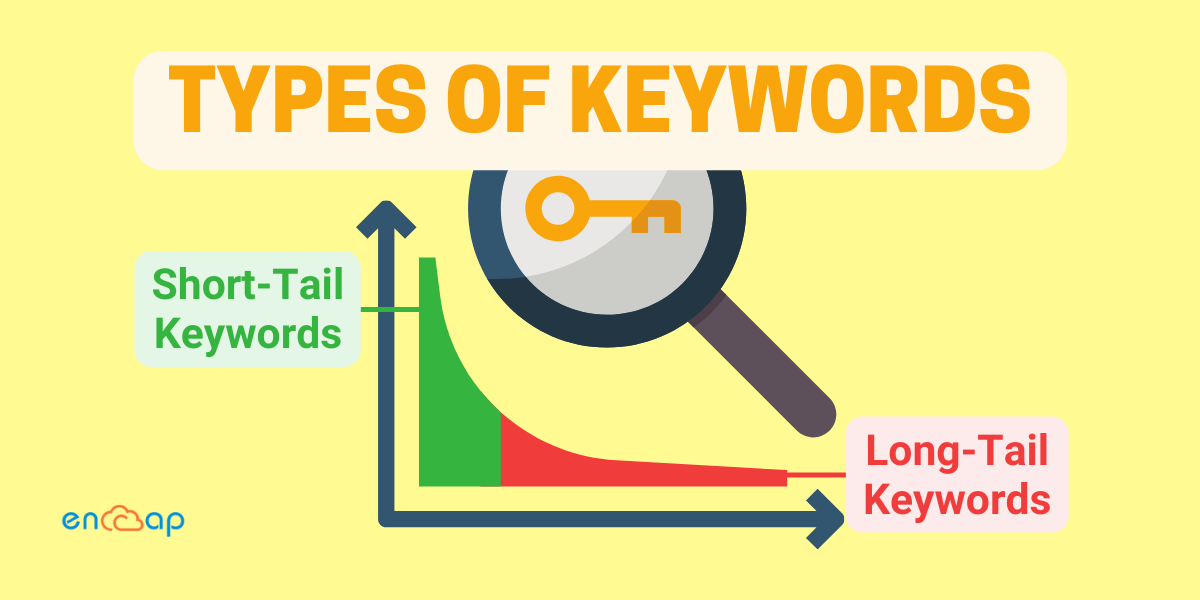
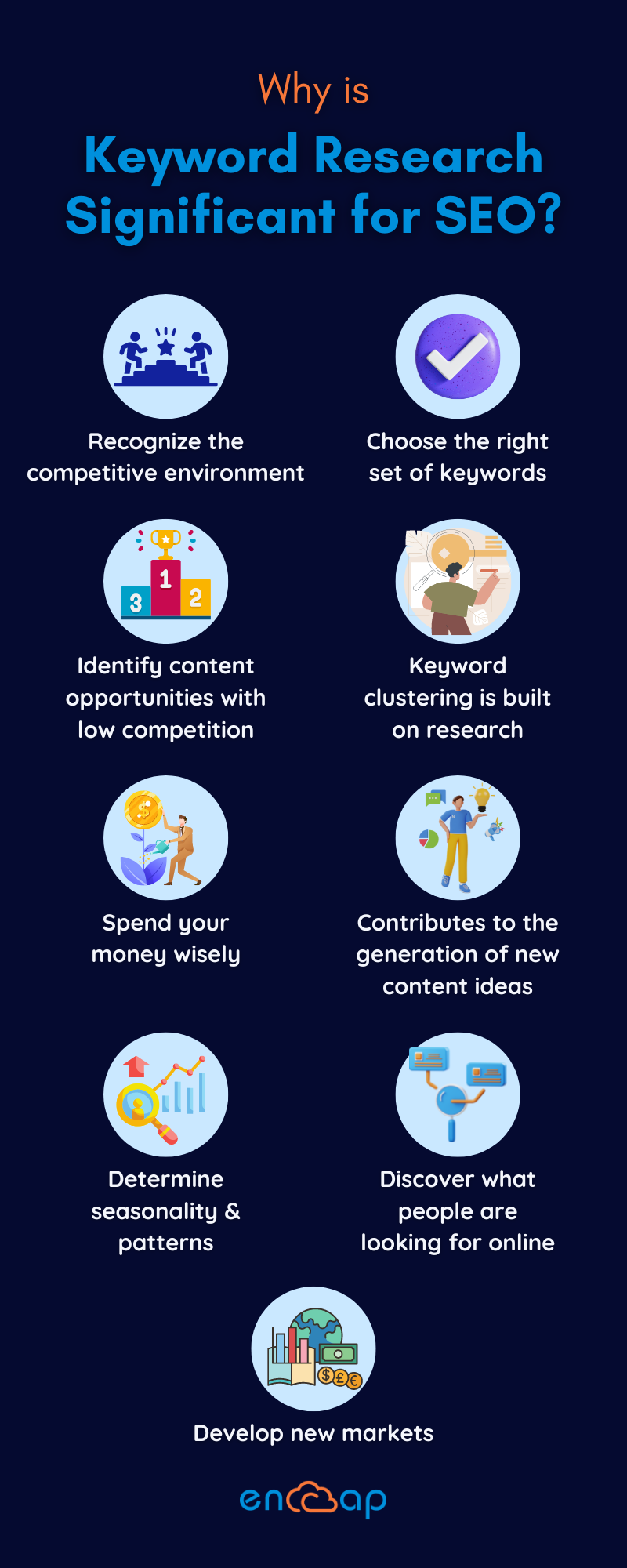
How to Choose a Top Digital Marketing Agency? Read More »

Digital Marketing, , , ,
SEO Audit - Why is it Important For Your Website_ Discover Top 10 Reasons Now! - Encaptechno

SEO Audit – Why is it Important For Your Website? Discover Top 10 Reasons Now!

SEO Audit - Why is it Important For Your Website_ Discover Top 10 Reasons Now!

One of the essential foundations of e-commerce and digital marketing services is Search Engine Optimization or SEO. SEO is a broad science that includes everything from keyword research and image optimization to backlink building and content generation. 

A well-executed Search Engine Optimization plan will increase the visibility of your website and products in search engines, resulting in increased organic traffic. Every company’s business card is its website, and when used correctly in marketing initiatives, it can boost your brand’s online presence. You probably already know how important a company’s website and search engine ranking are. 

What is an SEO Audit?

An SEO audit of your website is an in-depth examination of the numerous aspects that influence your site’s organic search engine performance on Google or Bing. SEO audits aid in the detection of both SEO and website performance concerns. 

For various reasons, including Google’s regular search algorithm adjustments and changes in user search behaviour, a website must be constantly analyzed and optimized.

  • An SEO audit will tell you how to improve your website so that it appears in the top searches of your target customers.
  • It will also aid you in creating your brand authority and increasing conversions.
  • In its most basic form, an SEO audit aims to evaluate your website’s strengths, shortcomings, and potential for long-term success.
  • An SEO audit is a vital health check that allows domain owners (you) to assess their website’s capacity to rank in the search engine results pages (SERPs) (search engine results pages).
  • It entails examining your site through the eyes of Google and other search engines. 
  • Additionally, an SEO audit allows you to identify areas that need improvement and activities that are harmful to your website’s rating. 
  • The SEO audit aims to find as many foundational errors as possible that affect organic search performance.

With SEO Audit, you can analyze the following most effectively:-

  1. SEO concerns of a technical nature
  2. Issues with the structure of the website
  3. Issues with on-page SEO
  4. Offsite issues 
  5. Problems with the user experience
  6. Gaps in content and opportunity
  7. Competitive market intelligence

An audit is a routine exercise that should be carried out regularly; it’s akin to a health check for your website. 

Importance of SEO Audit

Top 10 Benefits of SEO Audit - Encaptechno

61% of marketers conclude their top inbound marketing priority is enhancing SEO and growing their organic presence.

Aside from that, performing an SEO audit will benefit you in the following ways.

1. Know Your Competition

SEO audits can provide data about your competitors’ websites, including their strengths and weaknesses. Using SEO auditing tools, you may also conduct a full SEO assessment of your competitor’s site. You’ll discover their keyword ranking, backlinks, SEO strategies, and their limitations and strengths. For example, you can check which of their articles is the most popular or receives the most backlinks, and if their tactic is successful, you can copy their approach and improve your SEO results. You can also want to concentrate on keywords that your competitors aren’t performing well for and strengthen your position for those instead. Knowing your competitors is critical for your business, significantly if ranking higher than you on search engines.

2. Update with the Latest Trends

SEO is a highly dynamic subject with hundreds of standards of best practices constantly changing. For example, there was a time when submitting news releases to a dozen different press release agencies might result in a thousand valuable backlinks to your website. The same strategy could now result in your website being sandboxed. What about exact match anchor links, keyword density recommendations, and other ranking factors?

How are you believed to maintain with all of these changes? 

You don’t have to, though. An SEO audit using one of the SEO tools can aid in the identification of these outdated tactics.

3. Find Out Which Keywords Bring Maximum Traffic

We all want to rank organically for keywords with the most volume and relevance. Small and medium-sized firms’ websites, on the other hand, frequently rank higher for less competitive and long-tail keywords. Using keyword analysis as part of an audit, you may level the playing field by determining the most practical terms for your company and speciality. However, if those keywords aren’t bringing in any traffic, let alone the correct kind of traffic, it’s almost useless. If you’re ranking well for a keyword but getting little traffic from it, it’s possible that your buyer persona isn’t exploring that terminology or that it has a low search volume. An SEO audit will help you choose your target audience’s search phrases and variants. 

You can then use this information to fill in the holes in your SEO strategy by developing and optimizing content.

4. Insights into Website Traffic

You may find out about your search volume, URL clicks, and impressions your website produces on search results by performing a comprehensive SEO website analysis and using tools like Google Analytics and Google Search Console. Increased clicks and impressions are always a good sign that your SEO strategy is working – make sure you regularly keep track of this data. In addition, SEO audits are a great approach to examining and benchmarking your website for accomplishments, problems, and the best ways to improve it. A complete analysis will give you valuable insights into what you should include in your SEO strategy and changes to improve the performance of your website and, most importantly, earn a return on investment.

5. Spot Out-of-Date Information

The existence of outdated content could be one of the reasons why your organic performance is deteriorating. It’s critical to supply relevant and new content for your website to be seen and ranked by search engines. You can increase your search engine rankings and user experience (UX) with the correct SEO site assessment. There is nothing to get rid of old content on your website, just like there isn’t one for any other white hat SEO method. So start excavating as soon as possible. Some of the content on your website may be obsolete. It’s critical to provide search engines with not just relevant but also new content, as well as a cause to return. If no one visits or returns to your website after six months, reassess the content or remove it.

6. Identify and Resolve Both On and Offshore Problems

An in-depth website audit will assist you in identifying any offsite or onsite issues driving traffic away from your site. For example, spam, hidden content, hostile URLs, and backlinks are some problems driving traffic away from your website. These difficulties might have an impact on your website’s total traffic, as well as your conversions. A professional website SEO audit can help you locate and even fix these issues before they get out of hand.

7. Analysis of backlinks

Every search engine considers backlinks to be the essential ranking indication. Because backlinks are regarded as endorsements, their quantity and authority can disproportionately impact your SERP ranking and visibility.

Backlinks from anchor text, guest posts, and press releases are no longer available. Search engine algorithms have improved, and websites that employ shady tactics to get backlinks will be penalized. SEO audits allow you to examine the source of not just your backlinks but also those of your successful competitors. This will show you how to replicate their link strategy. Audits will also reveal low-quality backlinks from link farms or spam directories, harming your website’s search engine rating. The general rule is that the more reliable connections you have to great content, the higher your site will rank. So why do most people have no idea what domains connect to their websites if backlinks are so important? It is critical to understand where you stand. 

8. Maintain Your Website Rankings

Google’s algorithms are also updated regularly. These algorithm modifications are complicated to keep track of and may or may not impact your website’s ranking. This is where the SEO audit comes into action. SEO auditing tools use Google measurements to assist you in making data-driven and up-to-date recommendations on what adjustments to make to your website. In addition, search engines like Google, Yahoo, and Bing continually upgrade their algorithms to deliver better search results. You should be aware of these changes to make appropriate changes to your website’s content.

9. Improve Your Website’s Speed, Security, and User Experience

Search engines favour well-designed and well-maintained websites and those that are quick, secure, and provide a positive user experience. Consequently, they increase the visibility of such websites in their search engine result page or SERP rankings. However, clients frequently ask about website speed and efficiency in website construction. Fortunately, the time you create and design your website isn’t the only time you may influence its efficacy.

On the other hand, websites become heavier over time as thousands of lines of code are present at any given time, and security vulnerabilities will gradually accumulate unnoticed. 

Regular SEO audits will assist organizations in identifying emerging problems on their website and implementing corrective steps.

10. Improves Usability

The usability of your website is critical to your e-commerce success. It is concerned with logic, easy navigation, and usable interfaces. In general, usability refers to how easy something is to use. Your sales and conversion rates will not increase no matter how much traffic you have if your usability is terrible. The process of creating a website is a mix of science and art. We want a functional, user-friendly, but also attractive and memorable website. However, aesthetics might have an impact on your website’s usability. An SEO tool will assist you in identifying some of your website’s navigational, functional, and structural flaws. Resolving these issues can immediately improve your website’s usability and improve your clients’ experience.

Conclusion

Regular SEO audits are highly beneficial to a company’s website. The search engine market evolves rapidly, and what works now may not work in six months. Therefore, an SEO audit can strategically improve your website’s performance, improve SEO, and increase conversions if done correctly. In addition, conducting an SEO audit on your own may reveal several areas that want attention. Because you are so familiar with your website, crucial components of it may go ignored. That’s why getting a third-party SEO audit can be beneficial — you can compare the results to assess your website’s overall quality accurately.

Sure, you could do the audit yourself and get the same results, but with an SEO audit professional at Encaptechno that cares as much about your site and its rankings as you do, you can be confident in your SEO strategy. 

Get SEO Audit Now | Get SEO Consulation Now

SEO Audit – Why is it Important For Your Website? Discover Top 10 Reasons Now! Read More »

Digital Marketing, , , , ,
How to Develop a Content Marketing Strategy in 6 Easy Steps

How to Develop a Content Marketing Strategy in 6 Easy Steps?

How to Develop a Content Marketing Strategy in 6 Easy Steps

It does not matter if you have already started with content marketing or if you have been using a similar approach for some time. It is always a good idea to work on your content marketing plan while ensuring that it is always innovative, updated, and interesting for all customers. 

Regardless of who intends to purchase your products and services, the content marketing plan must be comprehensive and targeted. While the content marketing plan continues to grow in popularity, creating social media posts and blogs will not be enough for impacting the bottom line.

There must be a holistic strategy that allows you to succeed in content. Developing this strategy also supports the lead generation strategy and helps attract a clearly defined audience while generating profitable customer action.

In this blog, we will follow an in-depth guide on how to create a content marketing strategy for your business. In case you have been facing any challenges in planning for the coming year or require new ideas for your plan, then please keep reading.

What is a Content Marketing Strategy?

What is a Content Marketing Strategy?

A content strategy is like a plan needed to use the content to achieve business goals. You can use this content strategy for attracting your audience at each step of the funnel while also keeping them engaged even after they have made a purchase. 

For example, let us say that the overall goals of your business are about increasing brand awareness. To ensure this happens, you must implement a content marketing strategy focused on improving the search engine results. The plan should be such that it drives traffic to your products and services. 

Many new business owners may assume that a good content strategy is important, but the fact is that it is not so early on in your business. The truth is that producing high-quality content is invaluable in building trust with not just the present but also the new audience. It helps in creating authority in the market and also helps to succeed in the long run. 

Therefore, a good content plan is more like the foundation of attracting and pleasing an audience in a buyer’s journey. Other than attracting prospects to your brand, you can leverage a plan for customer satisfaction and sales enablement. 

Most marketers actively invest in a content marketing plan, which is why it is important to develop one that can stand out in your industry.

Things to Keep In Mind While Creating a Content Marketing Strategy

1. Readers of Content

You must know about your content’s target audience and how many audiences must be targeted for content creation. 

Think of it this way, a business can have more than one kind of customer easily. Similarly, a content marketing plan can also cater to more than one type of user as well. 

Using a wide range of content channels can help you in delivering content that is customized to each persona. 

2. Solving Audience Problem

A product and a service should solve a problem that the audience is facing. The content you create should teach your target audience about a problem so that they can identify and address it as well. 

The fact is that a good content marketing strategy will be able to support people on both sides of a product or a service. These people are the ones who are still trying to gain clarity on what the main challenges are, and the ones who are using a product or service are already overcoming the challenge.  

The notable thing is that the content reinforces the effective solutions that your business is offering. It also helps you to build credibility with your target audience. 

3. Your USP

It is likely that your competition will be selling similar products and services as you, which also means that your potential customers must know what makes you better or, at the very least different from others. 

It is possible that your primary asset could be that your company has been formed for many years. On the other hand, it is also likely that you may have a unique brand image that can make you stand out from your competition. 

If you wish to prove why your brand is worth engaging with, you must prove why you are worthy of listening to it in the first place. After you are clear about this message, you can create content that permeates this message. 

4. Content Formats

You must have an understanding of all formats that must be focused on while creating content. It is important to meet your target audience just where it is. You have to find out where your audience is passing its time.

If you do not then you will just be wasting time by creating content that will either fail to reach your audience or attract their attention. After you find the best formats for your brand, you can start creating a budget that can assess which resources can be allocated for executing a strategy.

5. Publishing on Channels

As you can create content in a wide range of formats, you can also easily publish it on various platforms as well. From creating content for your website to social media, the options are endless. This is also something that will reflect where your audience lives. 

In case your audience chooses long-form video content, then you might as well choose to publish your content on platforms such as YouTube. On the other hand, if you have a younger audience, then choosing platforms such as Instagram and TikTok can be useful. 

6. Aligning Content Creation and Publication

When you have got everything mentioned above in place, it is now time to create and even publish the content in an alignment. Who is creating what, where will it be published, and when is it going to be live? 

When you have a small team, this can be an easy thing to achieve because you are the sole decision-maker. However, with the growth of your company, you will be required to collaborate with many teams so that you can finally figure out an effective process. 

At present, content marketing strategies can be used for preventing clutter as it is easy to manage content from one standpoint. When it comes to planning a content calendar, you can easily see a company’s message and even assert yourself as an authority in the market with time. 

Steps to Create a Content Marketing Strategy

1. Define Your Goals

A good way to develop a content marketing strategy is by defining a clear goal for what you want the content to do. This can very well be a brief statement that makes it simple to focus on what is important and what is not. Create your content in a way so that the strategy can stay on track. 

The goal should include what your audience can get from your content marketing plan. You should also think about what your business can possibly get from your business. This is where the business goal comes in. 

In general, content marketing is done to improve revenue because of a content marketing strategy. It can also be used for making more sales and getting more leads which further helps in meeting your revenue goals. You can get more traffic on your website with good content, as more traffic will lead to better opportunities for meeting your goals. 

In addition, you can improve the business perception so that you have a better influence and authority as a thought leader in your industry. Make sure that you factor in the search engine ranking factors so that they lead to more traffic. 

Go ahead and reduce your costs so that the content becomes considerably effective. Also, remember that social media engagement can also help in boosting traffic and authority so that must be focused on too. After you have clarity on your goals, it is now time to move ahead to create a buyer persona so that the content can be created around it. 

2. Create a Buyer Persona

For developing a successful plan, you should be able to properly define the target audience of your content which is otherwise called a buyer persona. This is important for everyone who is starting a business and is new to marketing. 

Once you have clarity about your target audience, you can always produce considerably relevant and valuable content that the audience wants to read and convert on. In case you are an experienced marketer, your target might have changed. 

You must know if you wish to target a new group audience or work on expanding your current audience. In addition, you should also know if you wish to keep your target audience the same or not. Go back and revisit the audience parameters by carrying out market research every year so that your audience can grow. 

3. Carry Out an Audit

Right from the beginning, most brands begin with creating blog posts before anything else. They will hire a digital marketing agency to create on-site and off-site blogs in the starting. 

However, if you wish to start with different formats, you can carry out a document audit for assessing the top-performing and low-performing content types as well. This information can be used for informing which direction you should take next.

If you have been in the business for some time now, then you should take your time to review the content marketing efforts and the usual results that it brings. Try to know what you can do differently in the coming year and also set some new goals. 

You can also take some time to align your team goals with the goals of your organization. It does not matter which stage you are in, but a content audit can help in finding what resonates with the audience. You can make an effort to find gaps in the clusters and look for new ideas well. 

4. Plan a Calendar

The process of planning content enables you to allocate resources suitably. You can see which workflow is taking a longer time than was expected and also adjust your expectations accordingly. 

An important element of planning efficient content is called prioritization. When you plan your actions, you will also be able to find the most important tasks that can be tested easily. While doing this, take your time to secure your content marketing strategy from important roadblocks while finding more opportunities that can help you experiment and improve your results. 

You can also prioritize in many ways, including gains, the flow of the campaign, resources needed for creating the campaigns and the product or service launch.  Make an effort to form a long list of themes that are likely to be effective and also relevant for a long time. 

When you make a decision on whether to choose a topic or just assess it, you should be focused on the usefulness of the topic. You can use tools for automating this process. 

5. Create Your Content

The overall content quality must come before all else. This includes your desire to get ranked quickly and even produce more quality content. Whether you create the content yourself or you employ a digital marketing agency for creating it, make sure that it is completely original. 

It is not likely to capture the attention of the intended audience if you do not create original content. You should be willing to invest in people and resources so that you can do your research, come up with ideas, and even implement them into engaging content pieces. 

Avoid creating content that is based on a detailed analysis of other pages while talking about the same topic. Take a step ahead and work on creating unique data, research, and opinion on each content piece. This way, you will be able to build brand credibility and also establish the trust of your audience. 

6. Publish Your Content

A marketing plan can go beyond the kinds of content that you will create at last. It should also cover ideas on organizing your content in detail. Using a content calendar is going to help you in being on the right track when it comes to publishing a diverse and well-balanced library on the website. 

Moreover, you can also create a calendar, especially for social media, so that it helps in promoting and managing your content on different sites. So many ideas that you think will be classic, but that said, you should not ignore timely topics as well. Even though they may not form most of your editorial, they help in generating more traffic. 

Many brands depend on including popular holidays in their overall marketing efforts, but one does not have to limit things to important marketing dates. In case there are holidays that may appeal to the audience, it can be worth publishing on the blog or even on social media. 

Conclusion

Although the methods mostly used for delivering content to the prospects can change continuously, the important principles stay the same. You can choose a good content marketing strategy based on customer choice and reliable data.

It doesn’t matter if you are just getting started. The point is not to get intimidated by this process. You must move at an optimal speed and take consistent action. As you go ahead in your marketing efforts, you will discover that content marketing will put you in a place where you overcome your competition. 

Get Digital Marketing Consultation NOW

How to Develop a Content Marketing Strategy in 6 Easy Steps? Read More »

Digital Marketing, , , ,
Why-Is-Keyword-Research-Important-For-SEO?-Encaptechno

Why Is Keyword Research Important For SEO?

Keywords (also known as “SEO keywords”) are any words or phrases a user enters into a search engine to find specific information on the internet. The term is a portal that directs users to organic search results and, ultimately, to the website where they may find what they’re looking for.

That is why choosing the appropriate keywords is critical in SEO. Once you’ve identified words people use while searching for items in your niche, you can change your content strategy and SEO to target these phrases. Hence you will rank higher and receive more visitors.

Types of Keywords

1. Long-tail Keywords

Long-tail keywords are key phrases that contain five or more words. For example, a long-tail keyword might be “which is the fastest car in the world”?

Long-tail keywords are an excellent approach to gradually growing SEO traffic because competition for these keywords is significantly lower than for short-tail keywords. Furthermore, these keywords have excellent conversion rates because they are utilized by users looking for specific information, products, or services.

2. Short-tail Keywords

Short-tail keywords are precisely what their name implies: they are brief. These keywords are often one to two words long.

“Street food” is an example of a short-tail keyword.

If you conduct keyword research on this topic, you’ll see that the competitiveness and search volume for this term are significantly higher than the long-tail keyword, “which is the fastest car in the world. Because of the high degree of competition for this keyword, ranking for it will be highly tough, utilizing a large amount of effort and money.

Another thing to remember about short-tail keywords is that they are typically quite broad and untargeted. This implies that the conversion rates for these keywords are insufficient. Therefore, marketers and content creators should avoid targeting short-tail keywords, especially if the brand isn’t a market leader with a well-established reputation.

Keyword Research

The process of locating relevant, business-related keywords that people may search for on Google is known as keyword research. Keyword research identifies common terms and phrases people type into search engines to find the information they seek.

  • Keyword research in SEO is as essential to human survival as oxygen. Moreover, it’s critical for SEO success because you can’t reach them if you don’t know what keywords they’re using. 
  • You can increase the exposure of your blog posts, webpages, and other digital content by conducting thorough keyword research. 
  • 49 percent of the time, the top result in Google search results for a given search query (or “keyword”) receives the most traffic. The second results receive the most traffic, 22% of the time. By reaching the second page of Google, consumers have clicked on each result less than 1% of the time.
  • Keyword research entails researching and selecting words/keywords that consumers will use to discover answers to their queries in search engines. It is the first stage in creating an effective SEO strategy for your website. It could be a single word or several words. It aids in attracting a focused audience to your website via search engines. 
  • It is critical to select relevant keywords for your business or blog to reach the right individuals.

Keyword research can help you-

  • To recognize and connect out to your target audience
  • To find new things to cover on your website.
  • To obtain qualified leads
  • To increase your sales.
  • To improve ad campaign clicks and impressions.
  • To raise brand awareness.

Purpose Of Keyword Research

The practice of exploring general, industry-specific terms and phrases that drive search traffic to search engine results pages is known as keyword research. This is the mandatory true and first step in every website’s search engine optimization (SEO).

The keyword research aims to locate words and phrases users look for on Google and other major search engines. 

These phrases are associated with the items and services offered on your website. As a result, keywords are becoming more focused on searcher intent than ever before. 

A large part of keyword research entails understanding your audience and the questions they are asking, then finding methods to answer those questions in your content utilizing a combination of keywords and phrases.

Why Is Keyword Research Important For SEO?

Why-is-Keyword-Research-Important-for-SEO?-Encaptechno

Excellent keyword research identifies the terms, phrases, queries, and answers your users and customers care about. Your keywords should also help you achieve commercial objectives such as increasing pageviews, acquiring leads, or selling products and services.

You won’t be able to optimize photos, pages, and content strategy to drive qualified traffic to your website until you know which word or search term you want to rank your blog post at the top.

If you pick keywords that are irrelevant to your website or specialty and include them in your blog post, there is a better possibility that your blog post will rank higher in search results for a short period. However, you may lose traffic, and users will leave your site if you use incorrect keywords.

Google SERP may eventually detect this conduct, and you may lose traffic and potential users. This scenario will raise your site’s bounce rate, resulting in a drop in overall rating. It appears to be a negative factor for your website and will also increase your spam score. Make sure that you select the appropriate keywords for your website.

Let’s now dive into detail to study the importance of keyword research for SEO-

1. Recognize the competitive environment

By providing a clear image of who they’re competing against, keyword research helps SEOs grasp the competitive landscape.

Let’s imagine you have a concept for a piece of content you’d like to create. You can determine which domains are already competing for the relevant phrase (s) by conducting thorough keyword research. Keyword analysis reveals how difficult or simple it will be to rank at the top of Google and other search engines. This brings us to the next reason keyword research is essential for SEO.

Employing keywords to attract potential consumers more inclined to use or purchase from your website is critical. However, it is equally crucial to avoid employing “bad” keywords, which can attract readers who are likely to leave your page.

2. Choose the right set of keywords

You may employ the wrong keywords for your business if you do not conduct keyword research. Furthermore, because research is one of the initial steps in the SEO process, doing it incorrectly (or not at all) sets you up for disappointment. Poorly picked keywords include ones that include:

  • Incorrect usage
  • Low search volume

Low search volume keywords have few to no individuals searching for them. Therefore, content connected with these keywords is unlikely to be found because no one searches for it using those terms. With high competition keywords, it may take a long time for your content to be found online, or it may not rank. In addition, visitors that click on keywords that have no connection to your page are unlikely to stay on the page. 

This raises your page’s bounce rate, which negatively influences SEO. In addition, if you choose the wrong keywords on your page, your content may not even be found in an organic search.

Keyword research is paramount for SEO since it enables you to examine the volume and competition data for the words you intend to utilize. It also supports any future updates you need to make to your chosen keywords.

3. Identify content opportunities with low competition

You’ll be able to find low-competition content opportunities by conducting keyword research. By choosing low-competition keywords, you boost the likelihood of your content drawing more readers and organic traffic to your website via search engines. Keyword research will also tell which keywords you should avoid targeting due to established domains already ranking for them.

Most keyword tools may be utilized to locate low competition and weed out high competitiveness.

4. Keyword clustering is built on research

Keyword clustering is gaining popularity in SEO since it allows you to optimize a single page for multiple keywords and increase your ranking potential.

However, before you can begin clustering, you must first undertake keyword research. To construct a core topic, seek specific themes within your keywords. Analysis assists you in thematically grouping terms into a core theme with relevant subtopics. 

You can structure your content around these critical subjects to help your pages rank higher in search results.

5. Spend your money wisely

Monthly search volume statistics can forecast how many clicks each article will receive. It assists you in deciding where to direct your resources. For example, if no one searches for “blue clouds in a bottle,” it’s pointless to create a full-fledged guide for it. Take the search volume and difficulty numbers with a grain of salt because they are only estimates from third-party programmes. In actuality, zero volume phrases in SEO tools may have search volume. You can use them for directions.

6. Contributes to the generation of new content ideas

The final reason keyword research is vital for SEO is that it helps generate new content ideas. It can sometimes be challenging to develop new content ideas for your blog. 

Fortunately, most keyword research tools may be leveraged to discover new keywords and content ideas. By entering your competitor’s domain, you may find all the terms currently on their site and for which they are ranking.

7. Determine seasonality and patterns

Research enables you to identify seasonality and business patterns. Keyword research will provide insights into current trends and your prospects’ behaviour. So keep up with what’s famous and vital to your target audience and use that information to keep your content relevant.

Because of seasonality, keyword research is essential in SEO.

With search insight, you can stay up to date on the latest trends and changes in your sector. For example, tracking search phrases might provide insight into upcoming trends in your niche industry. 

Search intelligence is valuable for any organization since it may provide strategic direction to inform your marketing approach. The data includes SEO campaigns, PPC advertising campaigns, and SEO content optimization campaigns.

8. Discover what people are looking for online

A content developer can learn about what people are searching for online by conducting keyword research.

This data is critical because it provides content creators with fast feedback on whether or not a new idea is worth their time and resources. Essentially, you want to create content that targets terms people use to search for information online. 

It’s pointless to produce content based on what you believe your target audience is looking for.

9. Develop new markets

Keywords enable you to connect with people likely to be interested in your products or services. Long tail keywords, on the other hand, provide you with a deeper understanding of new markets that can help you build your audience. In addition, long tail keyword phrases are less frequently searched, allowing search engines to look up more words and connect you to more items.

People will believe your organization is more legitimate if it ranks higher on search engines. The more authentic and genuine your content is, the more people will believe it, and you will be far more likely to have clients return to develop new consumers. 

Keyword research should be used in all elements of your marketing initiatives.

The Bottom Line

Keyword research is critical for SEO. It exposes plenty of helpful information about your competitors and what content to create. However, the most crucial reason for keyword research is that it allows you to find out what people are looking for online. As a result, conducting keyword research should be the first step in launching a new SEO campaign.

Now that you understand how important keyword research is, engage a top SEO services company like Encaptechno. We always employ the most up-to-date technologies for keyword research and analysis and do our best to weed out irrelevant ones. 

Contact our team of SEO specialists today and get the best assistance.

Why Is Keyword Research Important For SEO? Read More »

Digital Marketing, , , , , ,
Scroll to Top